
How to Move a Couch Up or Down Stairs Without Damaging It (or Yourself)
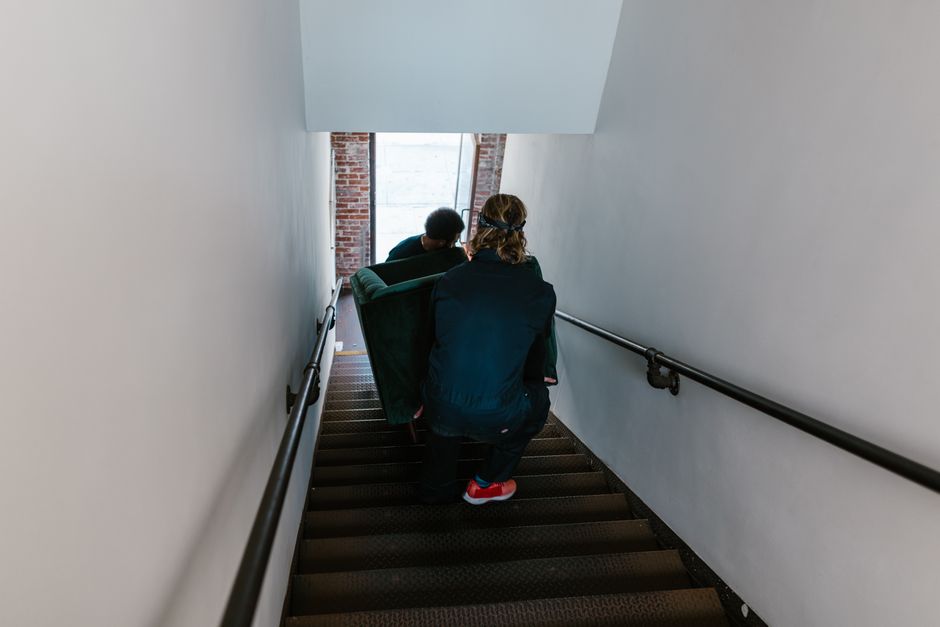
Knowing how to move a couch up stairs — or down them — is one of the most frustrating challenges of any residential move. It's the task that derails otherwise well-organized moving days, damages door frames, strains backs, and occasionally results in a couch that simply will not fit no matter how many angles you try. A sofa that traveled effortlessly into your current home can suddenly seem physically impossible to extract when a flight of stairs, a tight landing, and a narrow hallway all stand between it and the moving truck.
Need a professional crew to handle the heavy lifting on stairs and beyond? Call 224-404-0069 or get a free labor-only moving quote from Lift & Load today.
Why Moving a Couch on Stairs Is Harder Than It Looks
A couch on flat ground is manageable for two reasonably fit people with the right technique. The same couch on stairs introduces a set of compounding challenges that catch most people off guard. The weight distribution shifts dramatically when one end is elevated, the person on the lower end is bearing disproportionately more load, and neither person has full visibility of the path ahead. Add a landing that requires a 90-degree pivot, and you have a situation that rewards preparation and punishes improvisation.
The other underappreciated factor is the geometry of the couch itself. Sofas are almost always wider than they appear when you're trying to thread them through a stairwell. The arms, the back height, and the overall length all affect whether a given couch can make the turn at a landing. Before you attempt to move it, you need to know your couch's dimensions and compare them to the clearances you're working with — not estimate them.
Step 1: Measure Before You Attempt Anything
This step takes five minutes and can save you forty-five. Measure the couch in three dimensions: total length, total height (from floor to top of back), and total depth (front of seat cushion to back of sofa back). Then measure every chokepoint between the couch's current position and the truck:
- Stairwell width — measure at the narrowest point, usually where the wall meets the banister
- Landing dimensions — how much floor space do you have to pivot at each turn?
- Doorway height and width — both at the top and bottom of the stairs
- Ceiling height at the stairwell — critical if you're tilting the couch vertically
- Any overhead obstructions — light fixtures, smoke detectors, or low soffits
Write the numbers down. Don't trust your eye. A stairwell that looks wide enough almost never is, and a couch that looks like it will clear by six inches often clears by one — or doesn't clear at all.
The "Doorway Test" Before You Commit
If your couch must pass through a doorway at either end of the staircase, test that clearance first. Remove the door from its hinges — this alone can add an inch and a half to two inches of usable width. If the couch won't fit through the doorway even without the door, the staircase is irrelevant; you have a prior problem to solve. Some sofas must have their legs removed and cushions detached before they'll pass through a standard interior doorway.
Step 2: Strip the Couch Down Before You Lift It
Never attempt to move a couch on stairs in its fullest, heaviest configuration. Remove every detachable component before the couch leaves the floor:
- Cushions — seat cushions, back cushions, and any bolsters. Move them separately in bags or boxes.
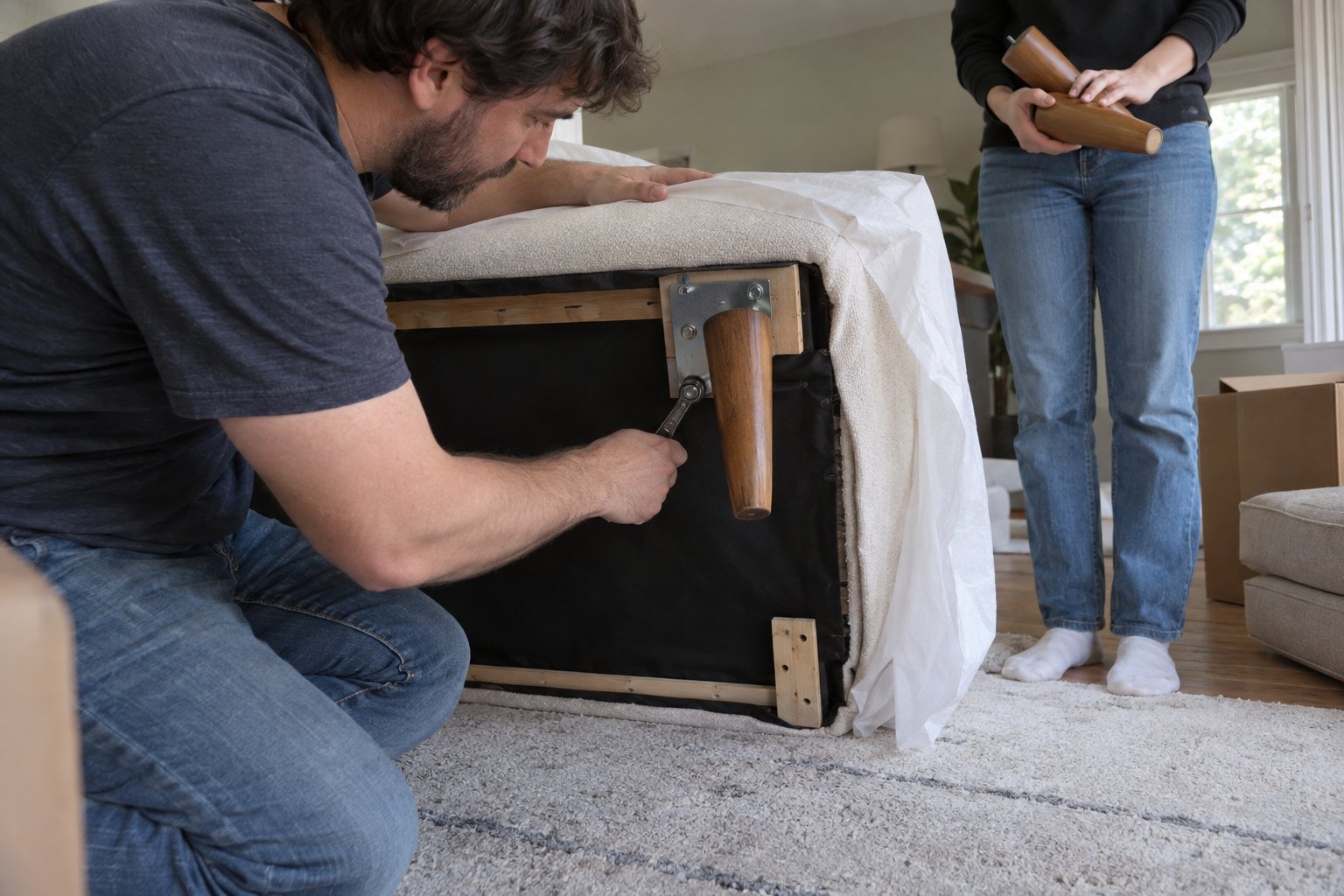
- Legs — most sofa legs unscrew. Removing them can reduce height by three to five inches and eliminate snagging points at the base of doorframes.
- Removable sections — if you have a sectional, separate every section before attempting the stairs. Moving a sectional as a unit on stairs is rarely necessary and almost always harder than moving the pieces individually.
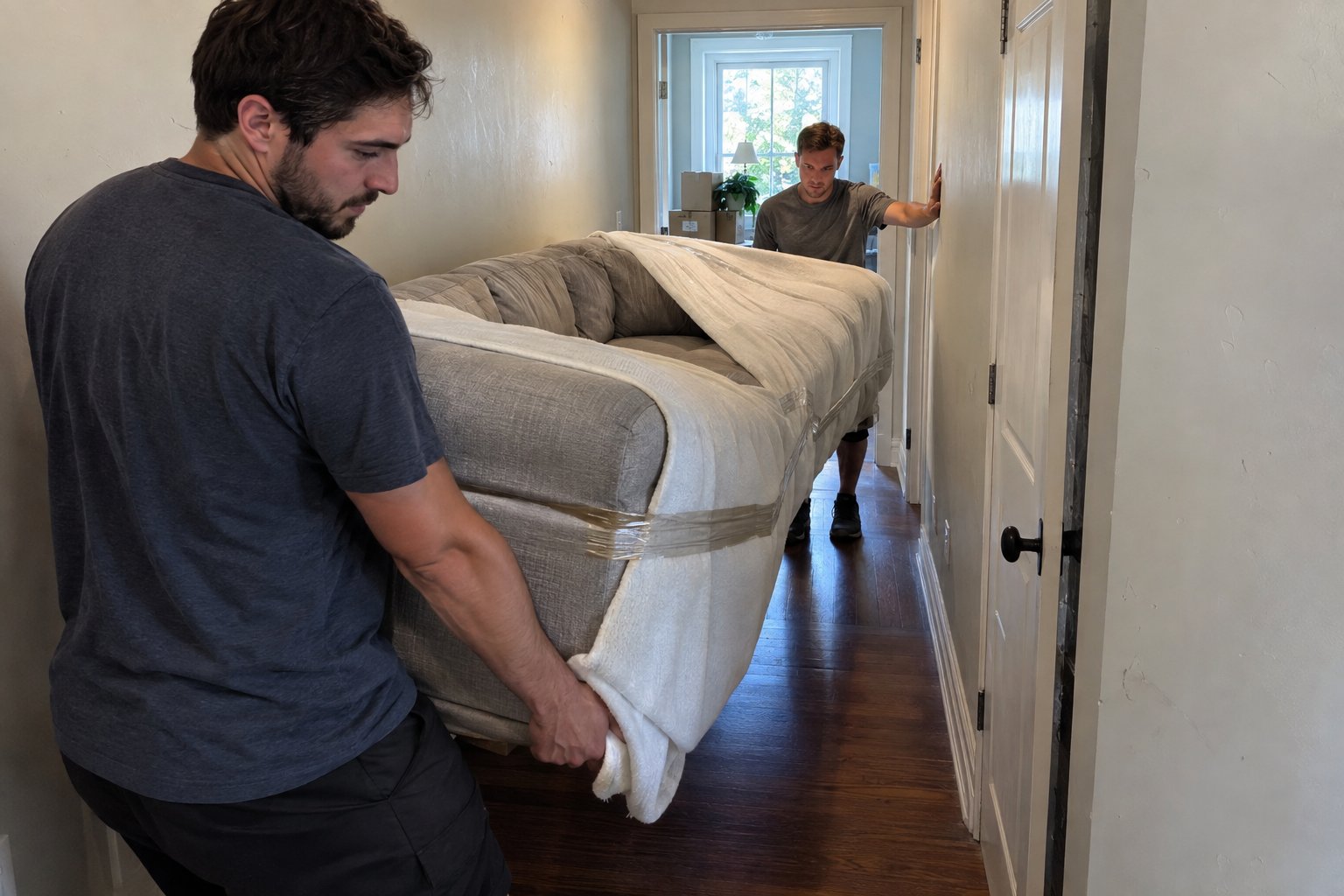
- Protective wrapping — wrap the couch frame in moving blankets and secure with stretch wrap before lifting. This protects both the couch and your walls from scrapes during the carry.
The goal is to reduce both weight and the couch's effective footprint as much as possible before you attempt the most challenging part of the move.
Step 3: The Right Technique for Carrying a Couch Up or Down Stairs
Technique matters as much as muscle when moving a couch on stairs. Here's the approach that professional moving crews use:
The Vertical Tilt Method
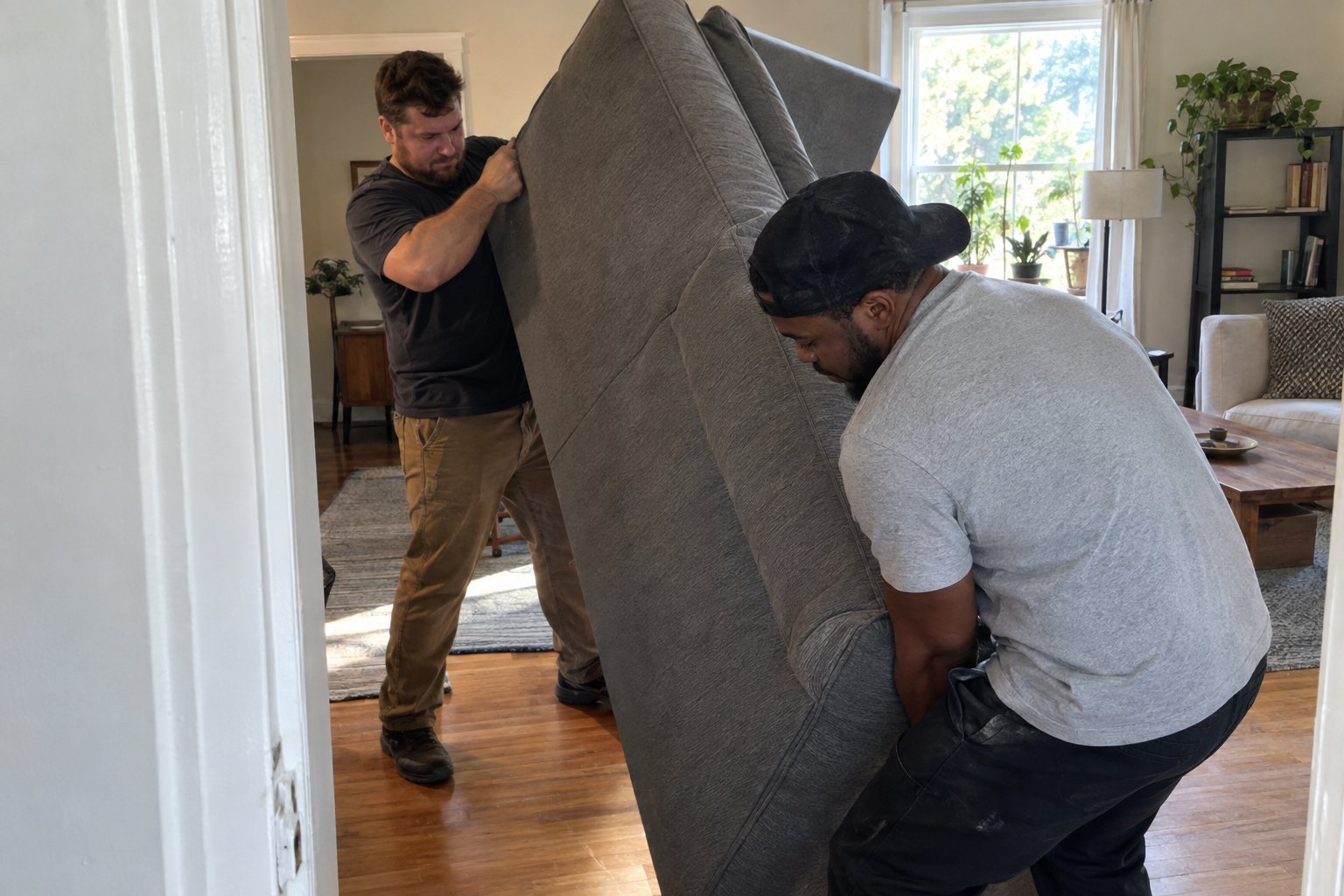
For most sofas, the most effective way to navigate a staircase is to tilt the couch up onto one end — turning it so the back is vertical and the seat faces the wall. This dramatically reduces the couch's effective width and allows the long dimension to run parallel to the staircase. One person guides from below while the other steers from above, and the couch travels up or down the stairs in a controlled, near-vertical orientation.
This method works best when your stairwell ceiling is high enough to accommodate the couch standing on its end. Measure the couch's length against your stairwell ceiling height before committing to this approach.
The Flat Carry Method
When ceiling height prevents vertical tilting, carry the couch horizontally but at an angle — with the leading end angled slightly downward on the way down, or upward on the way up. The person at the lower end carries more weight, so rotate positions at the landing if possible. Move slowly, call out each step, and never rush through a pivot.
Crew Positioning and Communication
The person at the top of the stairs has the better vantage point and should lead the navigation. The person at the bottom should not attempt to look backward down the stairs — they should focus on their footing and respond to verbal direction. Establish simple, clear commands before you start: "step," "stop," "pivot left," "set it down." Ambiguous communication on a staircase with a heavy couch is how injuries happen.
Use Furniture Straps if You Have Them
Moving straps (also called forearm forklifts or shoulder dolly straps) allow two people to carry a couch using their forearms rather than their hands, distributing weight through the large muscles of the shoulders and back rather than the fingers and wrists. On stairs, they provide meaningful control and significantly reduce fatigue. If you're moving anything heavy on stairs, these are worth the investment.
Step 4: Navigate Landings and Tight Turns
The landing at the top or bottom of a staircase is usually where moves stall. You've successfully carried the couch up the stairs, and now you need to pivot it 90 degrees in a space that may only be four or five feet wide. Here's how to execute this without destroying a wall:
- Plan the pivot before you get there — visualize the rotation and identify where each end of the couch will be as you turn.
- Use furniture sliders under the couch feet if it needs to rest on the floor during the pivot — this prevents floor gouging and makes repositioning easier.
- Take the couch high or low — sometimes the only way to make a tight landing turn is to angle one end of the couch steeply toward the ceiling or floor during the pivot. This is the classic "pivot!" problem, and it's often the right solution.
- Protect the walls — hang moving blankets over wall corners at the landing before you start. Landing corners are the single most common point of wall damage during couch moves.
When the Couch Simply Won't Fit: Honest Options
Sometimes, after measuring carefully and attempting every angle, the answer is that the couch cannot physically travel the path you've planned. This isn't failure — it's useful information that should surface before the moving crew arrives, not during it. If your couch won't fit on the stairs, here are your realistic options:
- Disassemble the frame — some sofas can be partially or fully disassembled. A furniture repair professional can often do this and reassemble at the destination. Ask the manufacturer whether your model supports this.
- Use a window or balcony — in some multi-story homes and apartments, large furniture is removed through a window using moving straps or a furniture hoist. This is a specialized job; don't attempt it without professional equipment and at least three people.
- Sell or donate and replace — if the couch is old, heavy, and difficult to move, sometimes the most pragmatic answer is to let it go and buy a new one at the destination. The cost of a new sofa may be less than the cost of a stair-related injury or structural repair.
Why Labor-Only Movers Are the Smart Call for Stair Moves
Staircase furniture moves are exactly the situation where professional labor-only movers pay for themselves. A crew that moves furniture on stairs every day knows the techniques, brings the equipment, and can assess your specific staircase and couch combination in minutes. They also carry the physical conditioning and body mechanics to do it safely — something that matters when you're talking about a 200-pound sofa on a steep staircase.
With a labor-only service, you're not paying for a truck you don't need or full-service pricing for services you're not using. You pay for the muscle and expertise, and you keep control of the rest of the move. For stair moves specifically, that value is direct and immediate.
Ready to stop worrying about the staircase and let a professional crew handle it? Call 224-404-0069 or get a free labor-only moving quote from Lift & Load today.

FAQs
For most standard sofas, two strong adults can manage a staircase carry safely when they use proper technique and furniture straps. For very heavy or oversized sofas — sectionals, sleeper sofas, or extra-deep designs — three people is strongly recommended. The third person can guide from the side on a landing, hold doors, or take over for a fatigued carrier. Never attempt a staircase sofa move alone.
Tipping the couch vertically — so the back stands upright and the seat faces the wall — is the preferred method for most staircase situations because it reduces the couch's effective width and lets the long dimension run parallel to the stairwell. The flat carry is used when ceiling height prevents vertical tilting. Measure your stairwell ceiling height against the couch's length before deciding which method applies to your situation.
It can, especially at staircase landings where tight turns force the couch close to corners. The best prevention is to hang moving blankets over wall corners before you start, wrap the couch itself in blankets secured with stretch wrap, and move slowly enough to maintain control throughout. Rushing is the primary cause of wall damage during staircase furniture moves.
Yes, in most cases. Staircase carries are the highest-risk moment of any furniture move, and professional movers handle them daily. A labor-only crew brings the right techniques, furniture straps, blankets, and body mechanics to do the job safely. The cost of a two-hour labor-only booking is almost always less than the cost of a back injury, a damaged couch, or a gouged staircase wall — and typically far less than full-service moving rates.
Yes, in most cases. Staircase carries are the highest-risk moment of any furniture move, and professional movers handle them daily. A labor-only crew brings the right techniques, furniture straps, blankets, and body mechanics to do the job safely. The cost of a two-hour labor-only booking is almost always less than the cost of a back injury, a damaged couch, or a gouged staircase wall — and typically far less than full-service moving rates.
Still have questions?
How to move with us?
Hit the “Get a Quote” button and tell us what you need.
Choose the service, date, and time that work best for you.
Our friendly team shows up on time and gets everything done safely.
Sit back while we take care of the rest.
.avif)