
Coffee Table Moves: What to Expect During Disassembly

Knowing how to move a coffee table correctly is something most people don't think through until they're crouched in the living room staring at a 120-pound marble slab sitting on a welded steel base, wondering how they're going to get it across the room without destroying the hardwood floors, cracking the stone, or throwing out their back in the process. A coffee table looks manageable. It's low to the ground, it's short, and it's usually the smallest large surface in the room. How hard could it be? The answer is: much harder than it appears, and the mistakes people make — picking up a glass top by its edges, skipping the leg removal step, dragging instead of lifting — routinely result in shattered glass, cracked stone, gouged floors, and strained wrists before the table ever makes it to the truck.
Need a professional crew to handle the heavy lifting so your coffee table and furniture arrive without damage? Call 224-404-0069 or get a free labor-only moving quote from Lift & Load today.
Why Moving a Coffee Table Is Harder Than It Looks
The first problem is material variety. Coffee tables come in a wider range of materials than almost any other piece of furniture — solid wood, tempered glass, plate glass, marble, travertine, concrete, metal, acrylic, and combinations of several at once. Each material has a completely different risk profile. A wood table is forgiving; a glass-top table is not. A stone table is dense and heavy far beyond what its compact footprint suggests. A concrete table can weigh 200 pounds or more and has essentially no safe grip points on its surface. The approach that works perfectly for one coffee table can destroy another.
The second problem is the low center of gravity combined with awkward carry height. Because coffee tables are designed to sit at seat height — typically 16 to 18 inches off the floor — they force carriers into a crouched position that puts significant strain on the lower back. You can't carry a coffee table at hip height the way you can carry a side table or a box. You either have to get low and stay low, or tilt the piece to carry it on edge — and not every coffee table can safely be tilted without causing structural damage or displacing a top that isn't fixed to the base.
The third problem is the legs. Most people treat the legs of a coffee table as an afterthought. They're not. Legs that are left attached during a carry are the single most common cause of coffee table damage. They snag on doorframes. They catch carpet fibers and cause the carrier to lurch. They extend the footprint in ways that make tight turns through hallways impossible without tipping the piece. On tables with thin tapered legs — mid-century modern styles, in particular — those legs can snap under lateral stress the moment the table is tilted even slightly to navigate a corner.
Step 1: Identify Your Coffee Table Type and Plan Accordingly
Before anything moves, you need to understand exactly what you're dealing with. Walk around the table and answer these questions:
- Is the top removable? Glass tops, stone tops, and some wood tops rest on a base without being fastened. Give the top a gentle, steady lift straight up to check. If it lifts freely, it must be moved separately from the base — never together.
- Are the legs removable? Screw-in legs are extremely common on mid-century and Scandinavian-style tables. Check under the table for a threaded bolt or a mounting plate with screws. If the legs come off, remove them before the carry.
- What does it weigh? A wood coffee table typically weighs 20 to 60 pounds depending on size and species. A marble-top table can weigh 80 to 150 pounds. A concrete slab table can exceed 200 pounds. If you're not sure, look up the model or estimate by material — stone is roughly 13 pounds per cubic foot for granite and marble, and more for concrete.
- Is there a shelf or lower tier? Two-tier tables have a second surface below the main top. That lower shelf limits how low you can grip the base and often collects items people forget to remove before the carry.
Once you know the table type, you can build the right plan. A lightweight wood table with fixed legs moves differently than a stone-top table with a removable slab and a powder-coated steel base. Treating them the same is how damage happens.
Step 2: Disassemble What Can Be Disassembled
The goal of disassembly is to reduce the weight of each piece and eliminate the protruding elements most likely to cause damage during the carry.
Remove the top if it's not fixed
Glass tops and stone tops should always be moved separately from the base. Lift the top straight up using both hands spread wide across the surface — never grip a glass top by just one edge. For large or heavy stone tops, you need two people and you need to communicate clearly about who is leading before anyone commits to the lift. Once removed, set the top on edge in moving blankets (never flat on a hard floor without padding) and transport it standing vertically in the truck, secured so it cannot tip.
Remove screw-in legs
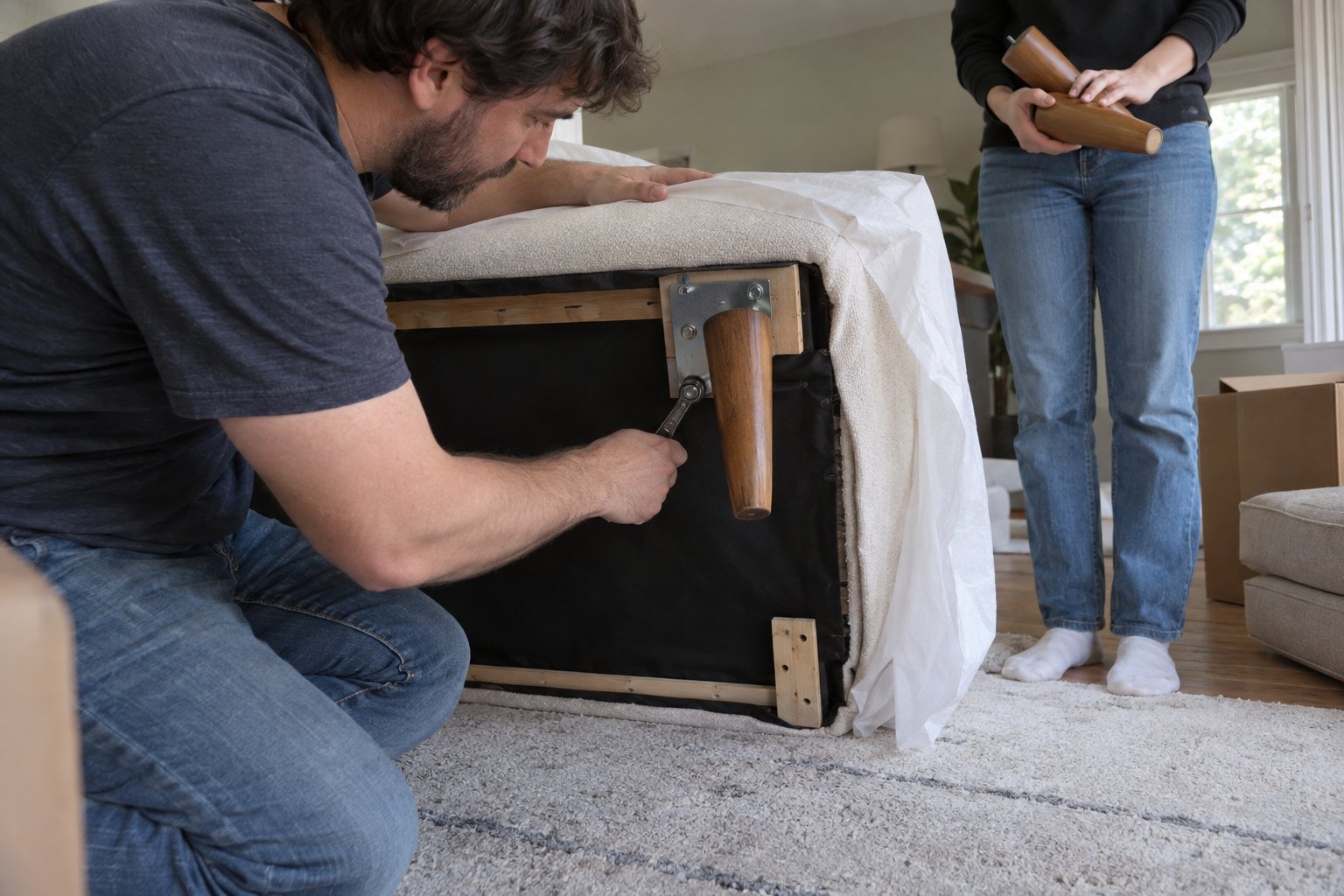
For tables with screw-in legs, unscrew each leg by hand and set them aside in a labeled bag with their hardware. Mark which leg came from which corner if there's any chance they're different lengths. Legs that are drilled and bolted through a mounting plate need a wrench — don't skip this step because you assume you can manage without it. Leaving a table's legs attached when they can be removed adds risk for zero benefit.
Clear the lower shelf
If your coffee table has a lower shelf or tray, remove everything on it. Even a stack of magazines and a candle adds weight to an already awkward carry and can shift mid-move. The lower shelf on many tables also means the table can't be set flat on the floor without resting on the shelf rim — which puts lateral stress on the shelf joints during loading and unloading.
Step 3: Wrap and Protect Every Surface
Coffee tables have a lot of exposed surface area relative to their size, and most of that surface is finished or fragile. Wrapping is not optional.
Wood tables
Wrap the entire table — top, legs, and apron — in moving blankets secured with stretch wrap or packing tape applied only over the blanket (never directly on the finish). Pay particular attention to corners, which are the most likely points of contact with door frames. If the legs are still attached, wrap each leg individually before wrapping the whole piece. A single unprotected corner contacting a door frame at carry speed can gouge a finish that took months to develop on a custom piece.
Glass tops
Wrap glass tops in several layers of moving blanket and then apply painter's tape in a grid across the face — not because tape strengthens glass, but because if the glass does crack during transport, the tape holds the pieces together and prevents a dangerous shattering event. Transport glass tops on edge in the truck, not flat. A glass top transported flat has its full surface area exposed to vibration and flex during transit, which is the most common cause of spontaneous cracking in tempered glass.
Stone and marble tops
Stone is heavy, dense, and brittle at thin cross-sections. The corners and edges of a marble top can chip from a single contact with a hard surface. Wrap in moving blankets and add cardboard corner protectors before wrapping. Transport on edge, same as glass. Never stack anything on top of a marble slab during transit.
Step 4: Carry the Table Correctly
With the table disassembled, wrapped, and ready, the carry itself is the final variable. Even at this stage, mistakes happen.
Two people for anything over 40 pounds
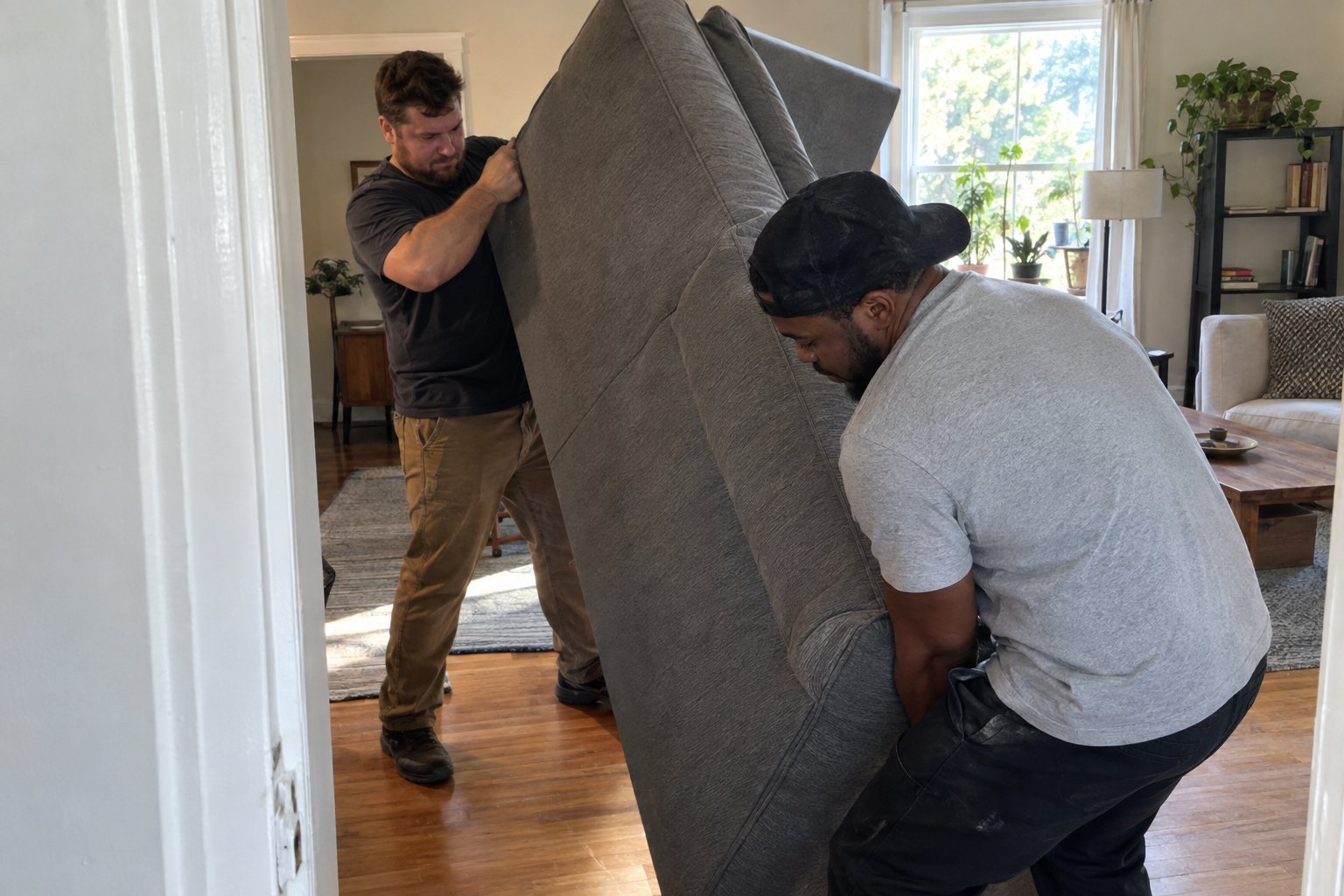
A coffee table that weighs more than 40 pounds should not be carried solo. The low carrying height forces your lower back into a position it was not designed to sustain under load. Two people can carry the piece at their sides, with one person at each end, maintaining a level plane throughout the move. Call out every change of direction, every threshold crossing, and every stair step before it happens — not while it's happening.
Carry on edge when possible
For rectangular coffee tables with solid frames and no risk of surface damage, tilting the table on its long edge and carrying it vertically dramatically reduces the footprint and allows a more natural carry position. Check first that the table's construction can handle this — a table with a glass or stone top still attached cannot be tilted on edge. A table with delicate inlaid surfaces on the top face should not be carried resting on that face.
Protect the floors during the move
Lay down floor runners or old blankets across the path of travel before the carry begins. A coffee table with a heavy stone top can leave deep gouges in hardwood if a corner drops even an inch. Once the piece is moving, it should never touch the floor until it reaches its destination — no setting it down mid-hallway to readjust grip. If you need to reset, set the piece on a blanket, not bare floor.
Step 5: Load and Secure in the Truck
How a coffee table rides in the truck matters as much as how it's carried out of the house. A table that's unsecured in a truck will shift, tip, and impact other items every time the truck brakes or corners.
Glass and stone tops go vertical and against the truck wall, standing on edge with a blanket between the top and the wall. Use moving straps or bungee cords to hold them upright — they cannot be left free-standing. A glass top that tips during transit breaks. It's that simple.
Wood coffee table bases can travel flat, upside down, or on edge depending on their shape. Upside down is often the most stable position for a four-legged wood table — it puts the flat top face down on a blanket and lets the legs point up, away from contact surfaces. Wrap the legs individually so they don't contact each other or adjacent furniture in transit.
Fill the space around the table with soft items — bagged clothing, pillows, cushions — to prevent it from shifting. A coffee table that has six inches of open space around it in the truck is going to use all of that space by the time the truck reaches the destination.
When to Call a Labor Crew Instead of Going It Alone
Most standard wood coffee tables are manageable for two careful people who follow the steps above. But there are situations where calling a professional labor crew is the right call — not because the task is impossible, but because the risk of damage or injury exceeds the cost of getting help.
- You have a stone, marble, or concrete top that weighs more than 80 pounds
- The table has a large plate-glass top that hasn't been removed before
- You're navigating stairs with a heavy base and a separate top
- The table is a high-value antique or custom piece where any surface damage is unacceptable
- You don't have a second person who can commit to clear communication and a controlled carry
A labor-only crew brings furniture dollies, the right moving blankets, and the experience to move heavy, fragile, or awkward pieces without the trial-and-error that causes most of the damage that happens during DIY moves. They also carry the liability — if something goes wrong during a professional carry, you're not the one absorbing the cost.
If any of those situations apply to your coffee table, get a free labor-only moving quote from Lift & Load and let a professional crew handle the heavy lifting while you focus on everything else the move requires.


FAQs
In most cases, yes — especially if the legs are screw-in style, tapered, or thin. Attached legs extend the footprint of the table, snag on door frames and carpet, and can snap under lateral stress when the piece is tilted to navigate corners or thresholds. If the legs unscrew or unbolt, remove them and bag the hardware before the carry begins. Fixed, welded, or fully integrated bases (such as on a pedestal or sled-base table) cannot be removed, so those pieces need extra care through tight spaces.
The glass top must be removed from the base and moved separately. Lift it straight up with both hands spread wide across the surface — never grip by a single edge. Wrap it in several layers of moving blanket and apply painter's tape in a cross-hatch pattern across the face to contain the glass if it cracks. Transport the top standing on edge in the truck, secured so it cannot tip. Never transport a glass top flat — horizontal transport across its full surface area increases flex and vibration, which is the most common cause of spontaneous cracking in tempered glass.
Position one person at each short end of the table. Before lifting, both people should agree on the carry height, the path of travel, and a clear communication plan — including what word means 'stop' and what means 'set it down.' Lift together on a counted signal, maintain a level plane throughout the carry, and call out every direction change, threshold, and stair step before reaching it rather than during. For very heavy tables (stone or concrete slabs over 100 pounds), consider using a furniture dolly to transport across flat surfaces rather than hand-carrying the full distance.
Lay floor runners, moving blankets, or heavy-duty cardboard along the entire path of travel before the carry begins. This protects both the floor and the table — if a corner drops unexpectedly, it contacts the runner instead of bare hardwood. If your table has a heavy stone or concrete top being moved separately, set it down only on the runner or a thick blanket, never directly on a finished floor. Once the path is cleared and protected, make sure the carry is a clean, continuous move with no mid-hallway rest stops on unprotected flooring.
Lay floor runners, moving blankets, or heavy-duty cardboard along the entire path of travel before the carry begins. This protects both the floor and the table — if a corner drops unexpectedly, it contacts the runner instead of bare hardwood. If your table has a heavy stone or concrete top being moved separately, set it down only on the runner or a thick blanket, never directly on a finished floor. Once the path is cleared and protected, make sure the carry is a clean, continuous move with no mid-hallway rest stops on unprotected flooring.
Still have questions?
How to move with us?
Hit the “Get a Quote” button and tell us what you need.
Choose the service, date, and time that work best for you.
Our friendly team shows up on time and gets everything done safely.
Sit back while we take care of the rest.
.avif)