
Recliner Moving Guide: Prepare, Angle, and Carry Safely

Knowing how to move a recliner correctly is something most people don't think through until they're standing in the living room staring at a 200-pound power recliner, footrest extended, back fully reclined, and wondering how on earth it's going to fit through a 32-inch doorway. A recliner looks manageable. It's just a big chair — how hard could it be? The answer is: considerably harder than it appears, and the mistakes people make — not locking the footrest, skipping the tilt maneuver, dragging instead of carrying — routinely result in torn upholstery, cracked reclining mechanisms, gouged floors, and at least one person with a strained back before the chair ever reaches the truck.
Need a professional crew to handle the heavy lifting so your recliner and furniture arrive without damage? Call 224-404-0069 or get a free labor-only moving quote from Lift & Load today.
Why Moving a Recliner Is Harder Than It Looks
The first problem is weight combined with an awkward shape. A standard manual recliner typically weighs between 90 and 140 pounds. A power recliner — one with an electric motor and a battery or cord — commonly weighs 150 to 250 pounds or more, because the motor, steel lift mechanism, and reinforced frame add substantial mass you can't see from the outside. That weight is also distributed unevenly. The base and mechanism are heavier than the back, which means the chair wants to tip backward the moment it's lifted off the floor. People who grab the armrests and try to walk it out of the room get an immediate lesson in why that doesn't work.
The second problem is the mechanism itself. Recliners have a reclining mechanism — a steel linkage system of bars, springs, and pivots — that allows the back to drop and the footrest to extend. That mechanism is not designed to absorb lateral stress, torsional flex, or impact. When a recliner is carried assembled without any support under the base, or when it's bumped into a door frame, the mechanism can bend, lose its detent positions, or stop latching properly at the upright position. A recliner that won't lock upright anymore is essentially broken, even if it looks fine from the outside.
The third problem is the footrest. On most recliners, the footrest is the leading edge of the chair when it's in the upright position. It extends forward when reclined and tucks under the seat when closed. During a carry, the footrest is almost never fully secured — it's held closed only by gravity and a spring. Any tilt, any bump, any moment of imbalance can cause the footrest to drop open mid-carry, which changes the chair's center of gravity instantly and without warning. A footrest that drops while someone is navigating a staircase is genuinely dangerous.
Step 1: Prepare the Recliner Before It Moves an Inch
Preparation is not optional. Every step below should happen before anyone tries to lift the chair off the floor.
Secure the footrest. The footrest must be fully closed and locked in the upright position before the carry begins. On manual recliners, push the footrest fully closed until you feel and hear the latch engage. If it doesn't latch firmly, use ratchet straps or moving straps looped under the seat and over the footrest frame to hold it shut. Do not rely on tape — tape will not hold the footrest against the weight of the mechanism during a tilt.
Secure or remove the back cushion and loose seat cushion if possible. Many recliners have seat cushions that are not attached — they rest on the seat deck. Remove them before the carry. They add weight you don't need and can shift mid-carry, changing your grip unexpectedly. If the back cushion is attached, make sure it's not going to flap open or catch on a door frame.
Disconnect power recliners completely. If your recliner has a power lift or electric recline mechanism, unplug it from the wall and untape the cord so it doesn't hang loose and catch on anything. Some power recliners have a battery backup — locate it and either remove it or secure it so it doesn't rattle free during the move. A swinging cord that wraps around a leg or snags on a stair tread is a trip hazard that can turn an awkward carry into a real injury.
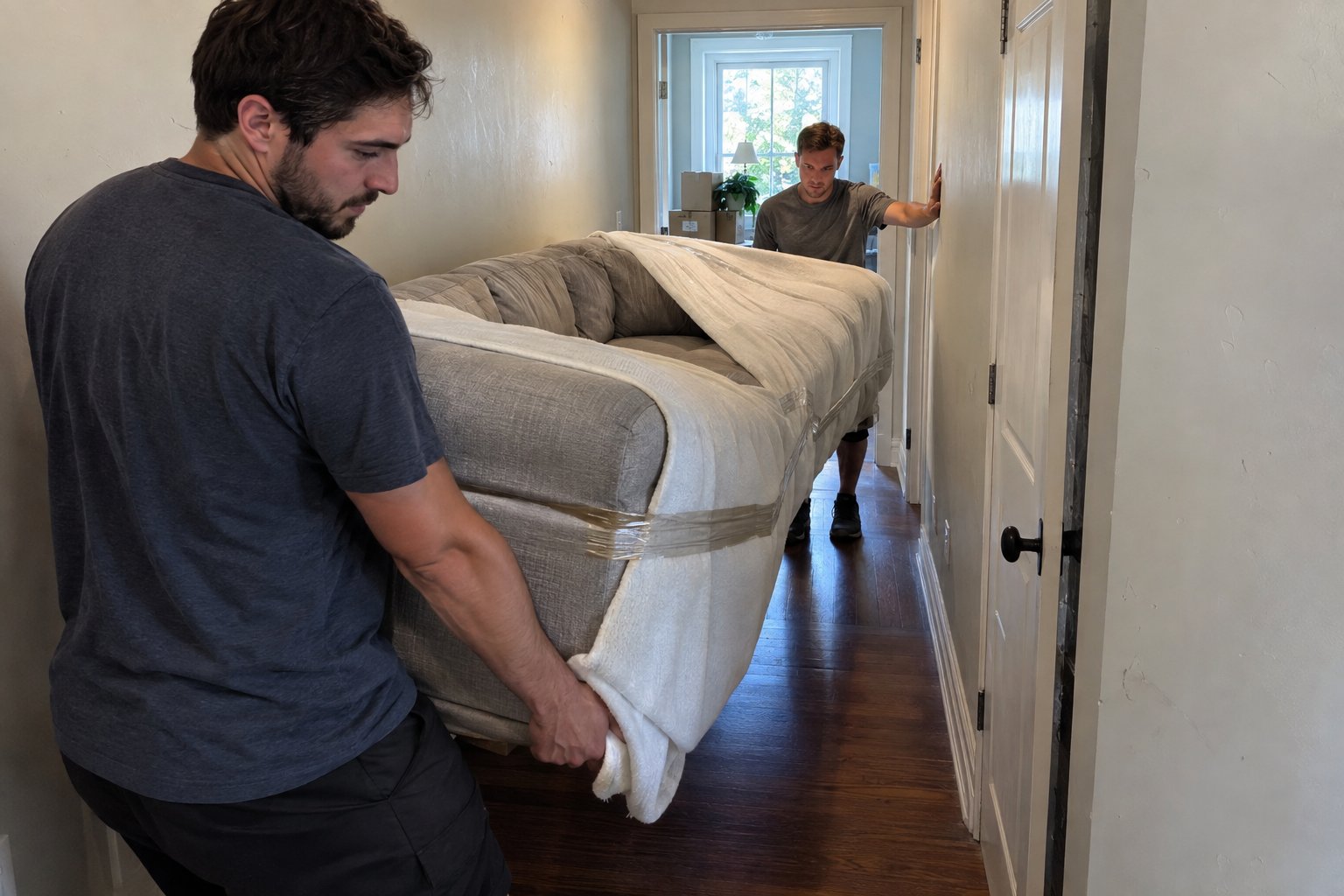
Wrap the chair before it moves through any doorway. Recliners are upholstered — fabric, leather, or synthetic — and upholstery tears, snags, and scuffs against door frames, stair rails, and truck walls with almost no provocation. Wrap the entire chair in moving blankets before it goes anywhere. Pay particular attention to the armrests and the corners of the seat deck, which are the first points of contact with any obstacle. Secure the blankets with moving straps, not tape directly on fabric or leather.
- Lock the footrest shut using straps if it doesn't latch firmly on its own.
- Remove loose cushions and move them separately.
- Unplug and secure all cords on power models.
- Wrap fully in moving blankets before the first doorway — not after.
Step 2: Measure the Doorways and Plan the Angle
Before anyone touches the recliner, you need to know whether it will actually fit through each opening on the route out of the building. This step prevents the scenario where you've carried a 180-pound chair halfway down a hallway and then discover the door opening isn't wide enough to pass it through in any orientation.
Measure the recliner in three dimensions: width (armrest to armrest), depth (front of footrest to back of chair in the upright position), and height (floor to the top of the headrest). Then measure every doorway on the route — width and height of the clear opening, not the door itself.
Standard interior doorways are typically 80 inches tall and 30 to 36 inches wide. A recliner's width — armrest to armrest — typically runs 30 to 40 inches. That means many recliners will not pass through a doorway in the upright, forward-facing position. The solution is to tilt the chair onto its back and carry it horizontally, or to angle it through the doorway on its side.
The Tilt Method
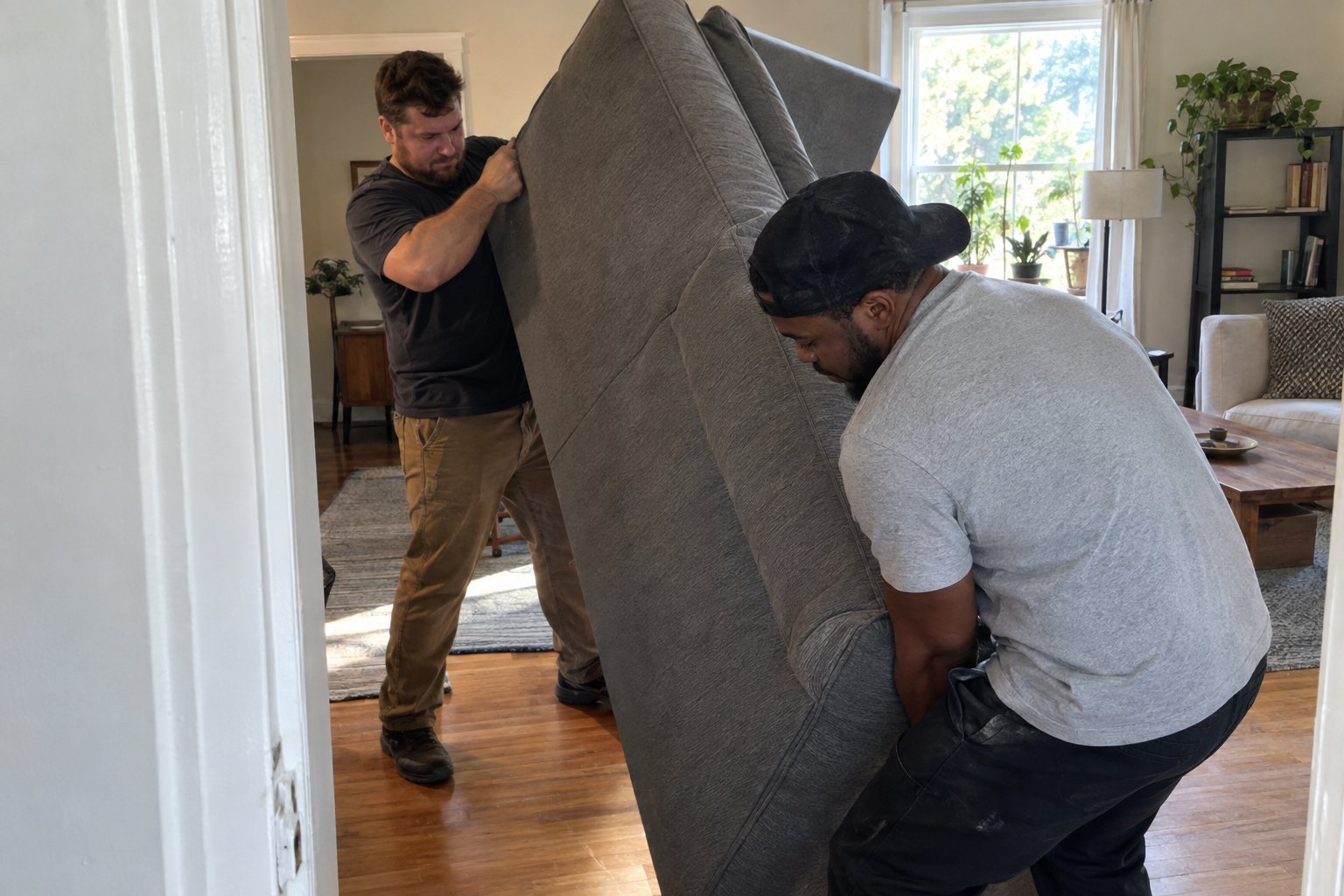
The most reliable technique for getting a recliner through a standard doorway is to tilt it so the back drops toward the floor and the footrest points toward the ceiling. In this position, the chair's footrest-to-back dimension becomes the vertical dimension, and the chair's width (armrest to armrest) is what you're navigating through the doorway. For most recliners, this gets the chair through a standard doorway cleanly. One person guides the top of the footrest through the opening while the other supports the weight of the back near the floor. This takes coordination and clear verbal communication — one person should be calling the moves, not both.
Navigating Turns
Hallways with 90-degree turns are where recliner moves stall. Before you start, walk the full route carrying nothing and think through every direction change. Identify where the chair needs to pivot, where you'll need to transition from horizontal to vertical carry (or vice versa), and whether any walls or stair rails will block the rotation. A dry run — slowly walking the path with arms out at chair-width — takes two minutes and can save a 20-minute problem mid-carry.
Step 3: The Actual Carry — Technique and Team
Moving a recliner correctly requires two people. It is not a one-person job under any circumstances. One person carries the top (headrest/back side) and one carries the bottom (base/footrest side). The person at the base is doing the heavier work — they're supporting the weight of the mechanism and base, which is where most of the mass is concentrated.
Lift from the base, not the arms. The armrests on most recliners are not structural carry points. They're attached to the frame with relatively lightweight fasteners designed to hold the armrest in place during normal sitting use, not to support the full suspended weight of the chair. Grab underneath the base — the solid wood or steel frame at the bottom of the chair — to lift. If the base isn't accessible, use moving straps under the seat deck.
Communicate on every step. The person at the back (headrest end) can't always see where they're stepping, especially on stairs. The person at the front should be calling out every step change, every obstacle, every turn. "Step down in two" is a sentence that prevents back injuries and dropped chairs.
On stairs, go slowly and stay low. Lead with the base going down stairs — the heavier end goes first, low, with the person carrying the base walking backward down the staircase. The person at the top (headrest end) keeps the chair tilted so its weight stays over the person descending, not pulling forward. Take one step at a time. Do not rush stairs with a heavy recliner.
Use furniture dollies where the floor allows. If you have a path from the room to the truck that runs across flat, hard flooring without any stairs, a furniture dolly under the base of the recliner can dramatically reduce carry time and physical strain. Tilt the chair back slightly, slide the dolly under the base, lower the chair onto it, and wheel it to the truck. On carpet, dollies don't roll effectively, so this method is floor-dependent.
Step 4: Loading the Recliner Into the Truck
Once the recliner reaches the truck, the loading position matters more than most people realize. A recliner cannot be stacked under other furniture in most cases — the back and arms are not load-bearing surfaces for other pieces resting on top of them. Placing boxes or other furniture on top of a loaded recliner can collapse the padding, damage the frame, or crush the armrests permanently.
The safest load position for a recliner in a moving truck is standing upright on its base, pushed against the truck wall, and strapped to the truck's tie-down rails. If space is extremely tight, a recliner can be tilted onto its back (footrest facing up) with moving blankets protecting all contact surfaces. Never load a recliner on its side — this puts lateral stress on the mechanism that it was not designed to handle.
Use at least one moving strap to secure the recliner to the truck wall before anything else is loaded around it. A recliner that shifts during transit and impacts other furniture or the truck wall can suffer mechanism damage that isn't visible until the chair is at the destination and someone tries to recline it for the first time.
When to Call a Labor Crew Instead
Some recliners — particularly large power recliners, lift chairs for elderly users, or oversized sectional recliners — are simply too heavy and too mechanically complex to move safely without professional help. Power lift chairs alone can weigh over 200 pounds and have wiring that runs through the frame in ways that make disassembly non-obvious. Getting it wrong means a broken motor or a chair that no longer lifts the way it's supposed to.
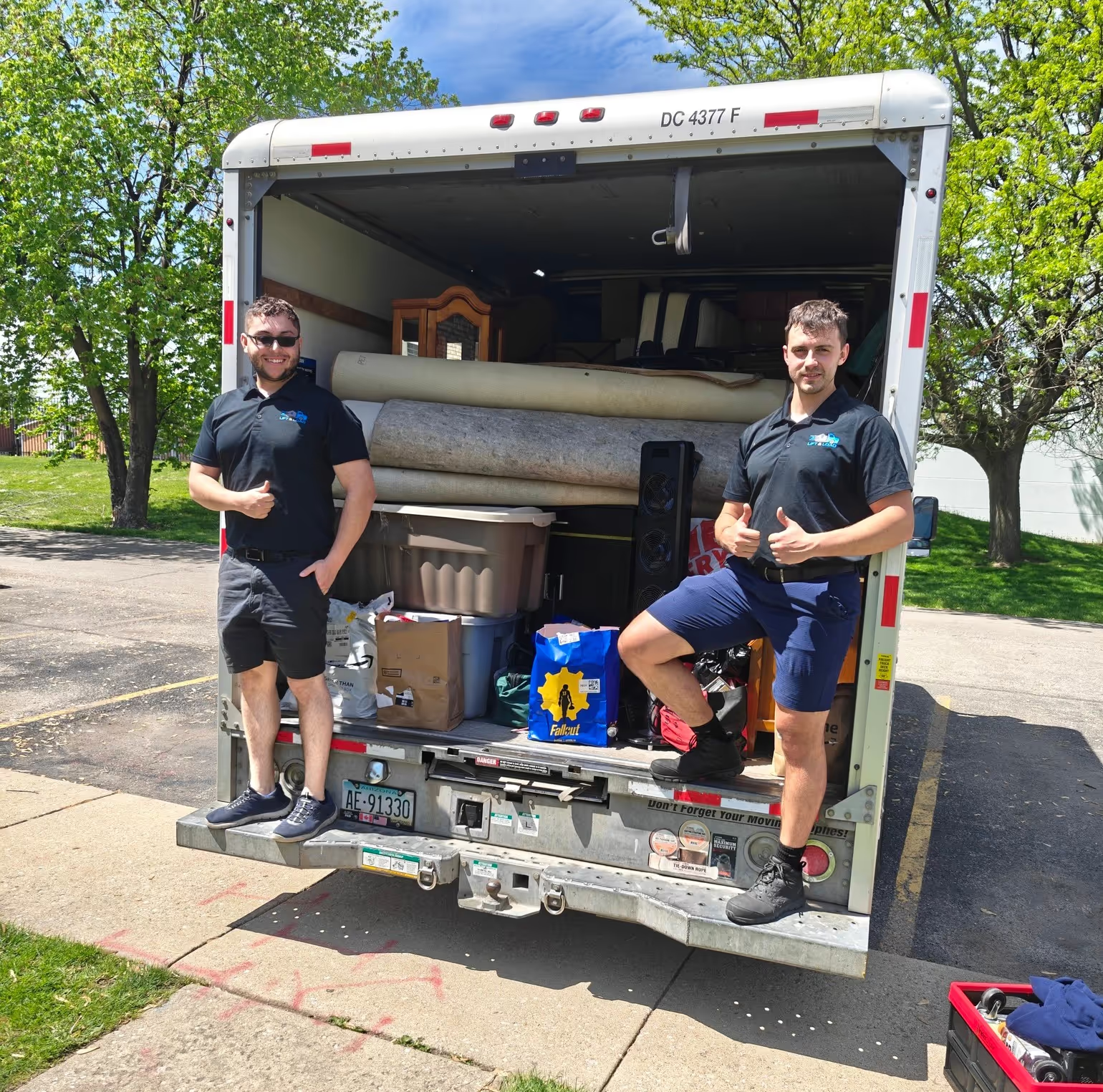
A labor-only moving crew brings the equipment, technique, and experience to move recliners — including power models and oversized pieces — without damage to the chair, the floors, or the walls. If the weight exceeds what two people can safely manage, or the route involves tight stair turns, booking a professional crew is the right call.



FAQs
Most recliners do not need to be fully disassembled, but many models have a removable back that detaches by releasing two levers or clips where the back meets the seat. Removing the back reduces the overall height and weight significantly, which makes the carry through doorways much easier. Check the underside or back of your chair for these release points before assuming disassembly isn't possible. Power recliners should always have the cord disconnected and secured before the move regardless of whether you remove the back.
The standard technique is the tilt method: tip the recliner so the back drops toward the floor and the footrest points up toward the ceiling, then carry it horizontally through the doorway. This converts the chair's depth dimension into the vertical and lets the width (armrest to armrest) pass through a standard 32–36 inch opening. Make sure the footrest is strapped shut before attempting this — a footrest that swings open during the tilt will shift the center of gravity unexpectedly.
Moving a recliner solo is not recommended for most situations. Standard recliners weigh 90–140 pounds, and power recliners often exceed 180–200 pounds. Beyond raw weight, the awkward shape and off-center mass distribution make a recliner extremely difficult to control alone — especially on stairs or through tight doorways. If a single person absolutely must move a recliner a short distance on flat, hard flooring, a furniture dolly is the only practical approach. For any stair carry or longer route, two people are the minimum safe crew.
Leather requires more care than fabric upholstery because it scratches and scuffs against surfaces that fabric would simply slide past. Wrap the entire chair in moving blankets before it contacts any door frame, stair rail, or truck wall. Do not use plastic stretch wrap directly against leather — it can trap heat and humidity and leave marks or slight surface changes on natural leather over a long transit. Use the blankets as the first protective layer and stretch wrap over the blankets if you need to hold them in place. At the destination, remove the blankets promptly and allow the leather to breathe.
Leather requires more care than fabric upholstery because it scratches and scuffs against surfaces that fabric would simply slide past. Wrap the entire chair in moving blankets before it contacts any door frame, stair rail, or truck wall. Do not use plastic stretch wrap directly against leather — it can trap heat and humidity and leave marks or slight surface changes on natural leather over a long transit. Use the blankets as the first protective layer and stretch wrap over the blankets if you need to hold them in place. At the destination, remove the blankets promptly and allow the leather to breathe.
Still have questions?
How to move with us?
Hit the “Get a Quote” button and tell us what you need.
Choose the service, date, and time that work best for you.
Our friendly team shows up on time and gets everything done safely.
Sit back while we take care of the rest.
.avif)