
Couch Moving Mistakes That Lead to Injuries or Damage
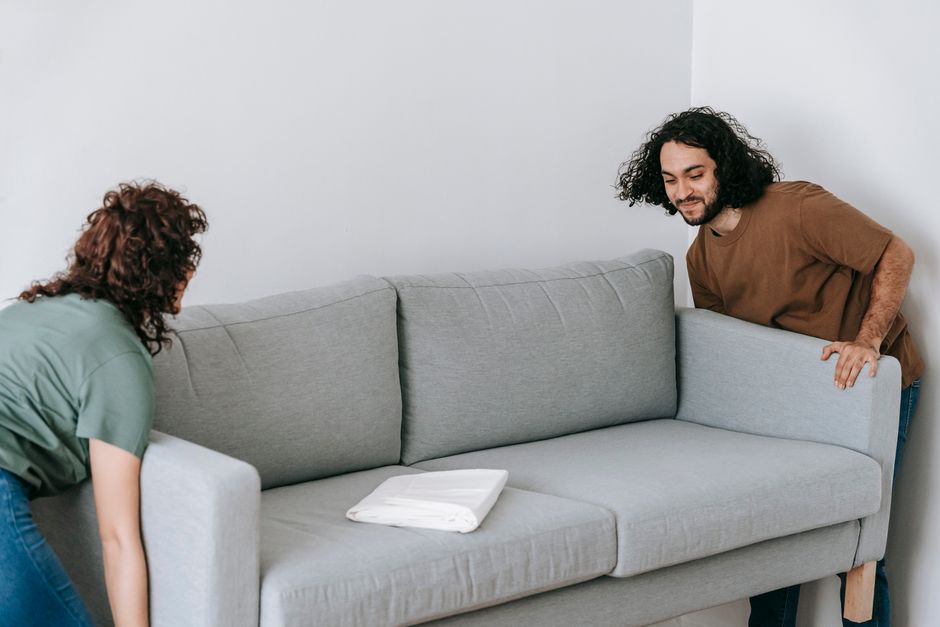
Knowing how to move a couch correctly is something most people don't fully think through until they're standing in the living room staring at a 90-inch three-cushion sofa, measuring tape in hand, realizing for the first time that the front door is 32 inches wide and the hallway makes a 90-degree turn before it even gets there. A couch looks like the most approachable large item in any home. It has cushions you can remove, legs you can unscrew, and fabric that gives it a softer feel than a steel filing cabinet or a refrigerator. How hard could it be? The answer is: considerably harder than most people expect, and the mistakes people make — skipping measurements, leaving legs on, carrying without coordination — routinely result in gouged doorframes, torn upholstery, and at least one person with a strained lower back by the time the piece hits the truck.
Need a professional crew to handle the heavy lifting so your couch and furniture arrive without damage? Call 224-404-0069 or get a free labor-only moving quote from Lift & Load today.
Why Moving a Couch Is Harder Than It Looks
The first problem is size relative to structure. A standard three-seat sofa runs roughly 84 to 96 inches long, 32 to 38 inches deep, and 30 to 36 inches tall. A sectional can push well past 110 inches across its longest dimension. Neither has a shape that naturally fits through a standard doorway. Standard interior doors are 80 inches tall and 30 to 36 inches wide — and the couch almost always needs to be tilted, angled, or rotated to pass through them at all. The problem isn't just the door opening itself; it's that couches are rigid in ways that aren't immediately obvious. The frame, typically made of kiln-dried hardwood, engineered wood, or steel, does not flex. You cannot squeeze a couch through a gap that's too small. The math is exact, and you have to do it before you start moving.
The second problem is weight distribution. A large fabric sofa can weigh anywhere from 150 to 300 pounds depending on the frame material, cushion fill, and whether it has a pull-out sleeper mechanism inside. Sleeper sofas are a special case — the addition of a steel fold-out mattress frame can add 80 to 100 pounds to the base weight and shift the center of gravity in ways that make the piece feel completely different from a standard sofa of the same exterior dimensions. The weight is also distributed unevenly: the frame is heavier in the base and along the arms, while the back is comparatively lighter — which means two people carrying a couch are almost never carrying equal loads.
The third problem is the absence of real grip points. A filing cabinet has drawer pulls. A refrigerator has door handles and defined edges. A couch has upholstered armrests that are not structurally designed to support the full weight of the piece from below, and a fabric or leather surface that provides no friction against a sweaty palm or a moving blanket. People grab couch arms from the bottom and hoist. The arm frame takes the load, the joint between arm and base stresses, and over time — or in one bad moment on a staircase — that joint cracks, the arm wobbles, and the piece is damaged in a way that's essentially impossible to repair invisibly.
Step 1: Measure Everything Before You Touch the Couch
Every couch move starts with a tape measure, not with your hands on the furniture. Measure the couch in three dimensions: length, depth, and height. Then measure every doorway, hallway, and stairwell it needs to pass through. The critical number for doorways is the diagonal clearance — the diagonal measurement of the couch's cross-section (height × depth), which tells you the minimum door height you need to tip the piece upright and pivot it through. For most standard sofas, this calculation determines whether the couch can be angled through a doorway at all.
Measure hallway width, not just doorway width. A hallway that is 42 inches wide may seem comfortable, but when you're pivoting a 90-inch sofa from a hallway into a room, the hallway acts as a lever arm — you need enough length in the hall to complete the rotation. This is the same geometry puzzle that appears in the famous "moving sofa problem" in mathematics, and it's genuinely difficult to visualize without measuring. If your hallway is short and makes a sharp turn, you may need to remove the couch's legs and possibly a door from its hinges before you can make the move work at all.
Step 2: Disassemble What Can Be Disassembled
Before lifting the couch a single inch, remove everything that can come off without tools or with minimal effort:
- Cushions and throw pillows — Remove all seat cushions, back cushions, and bolster pillows. This reduces weight, prevents cushions from shifting mid-carry and throwing off your balance, and protects the fabric from compression damage.
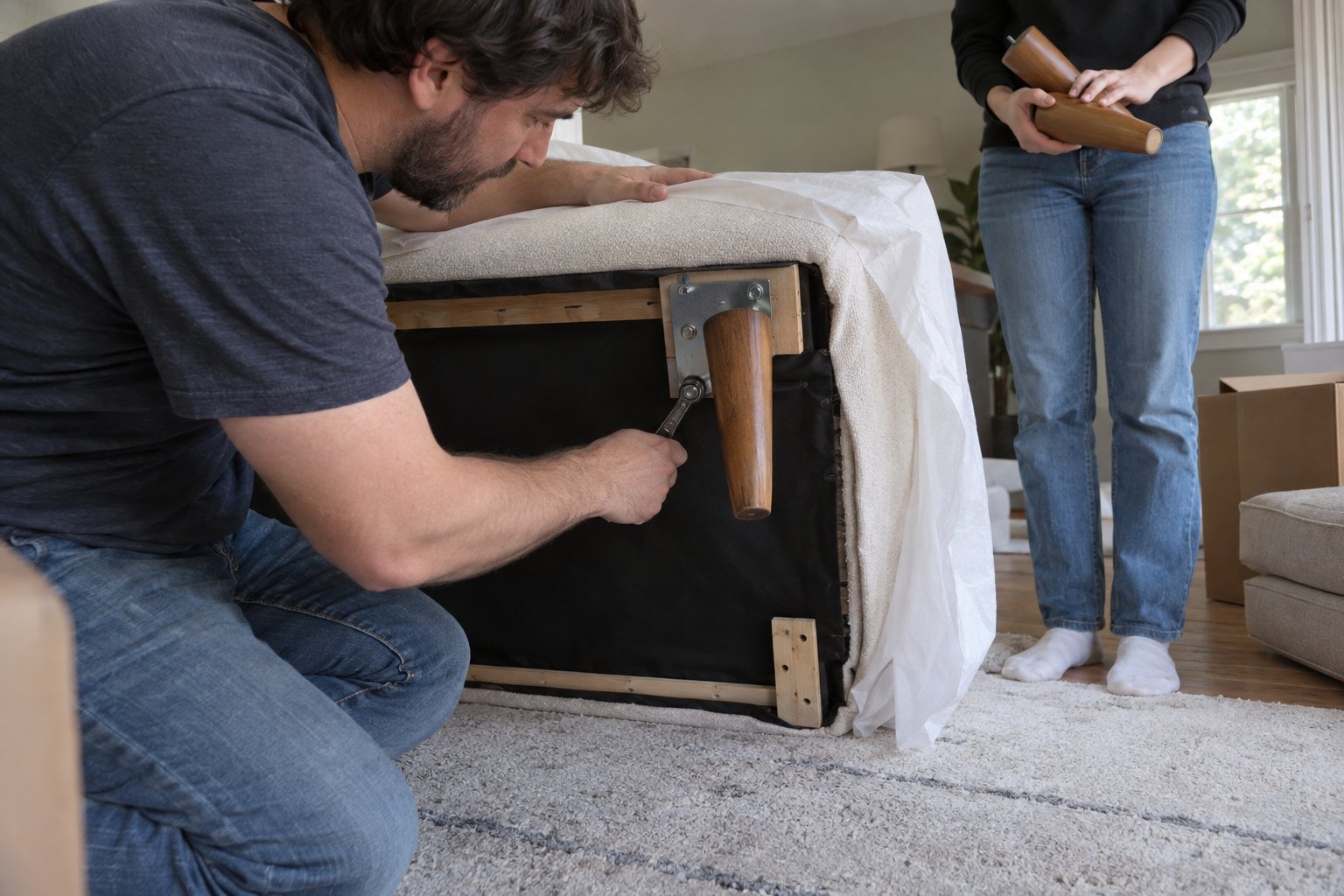
- Legs — Most sofa legs unscrew counterclockwise by hand or with a flathead screwdriver inserted into a slot on the underside of the leg plate. Removing legs drops the couch's height by 4 to 8 inches — a meaningful reduction when you're trying to clear a door header or tip the piece upright in a stairwell. Bag the legs and hardware together and tape them to the underside of the frame.
- Sectional connectors — If you have a sectional sofa, locate the connecting clips or brackets between sections (usually metal hooks or cam-lock fasteners accessible by flipping seat cushions). Separate the sections. Moving a two-piece sectional is almost always easier than attempting to maneuver it as a single unit, even if each individual section is still heavy.
- Sleeper mechanism — Do not remove the sleeper frame from a pull-out sofa unless you have genuine mechanical experience. Instead, fold the mattress back into the closed position, confirm the locking mechanism is fully engaged, and tape the frame closed with a ratchet strap around the body of the sofa so the mattress cannot fly open during movement.
Step 3: Protect the Upholstery Before It Leaves the Room
Couch fabric — whether it's microfiber, velvet, bouclé, genuine leather, or bonded leather — is one of the most vulnerable surfaces in any move. A single pass against a rough doorframe edge can snag fabric, crack leather, or leave a permanent scuff. Protecting the upholstery is not optional; it takes five minutes and prevents damage that can cost hundreds of dollars to repair.
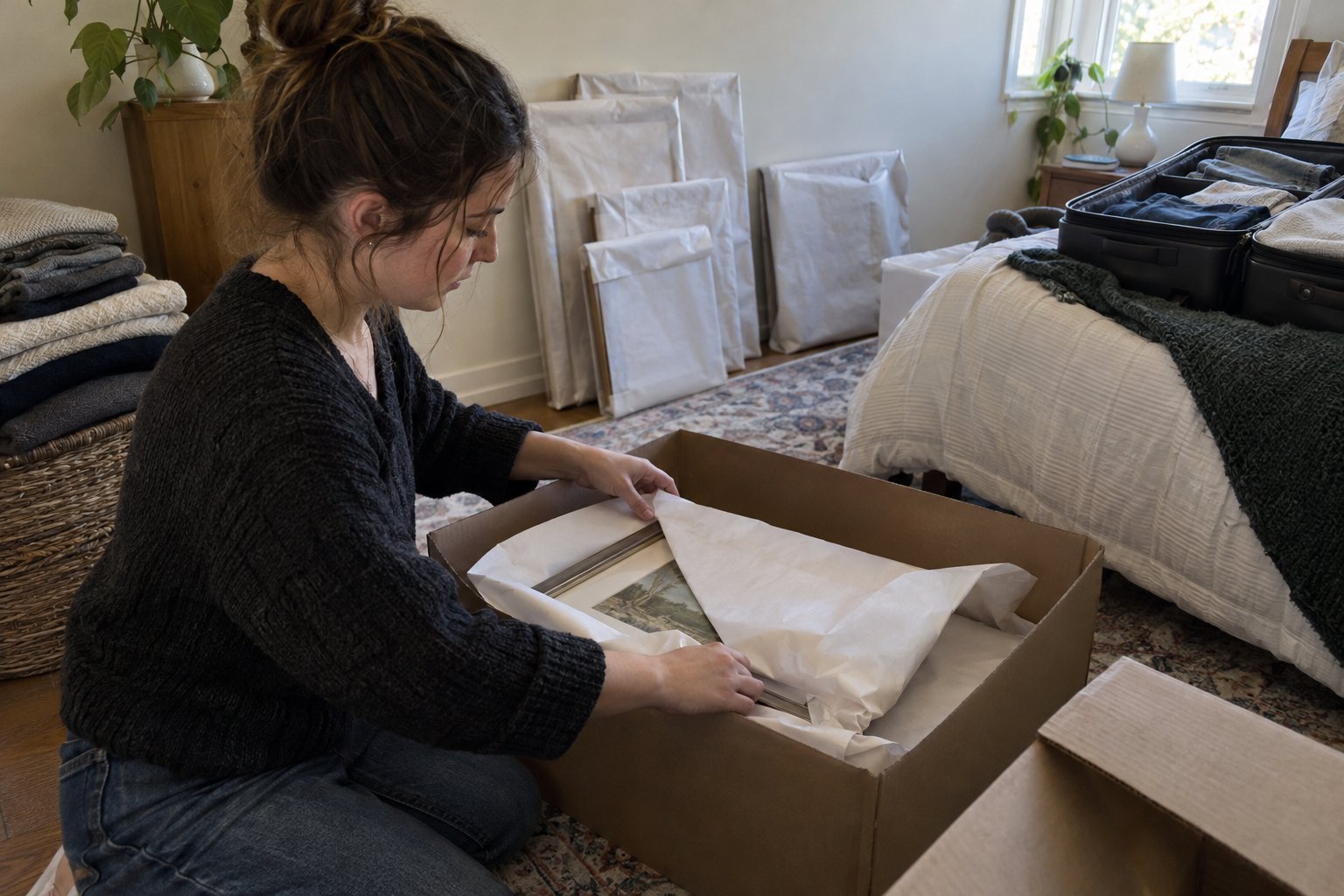
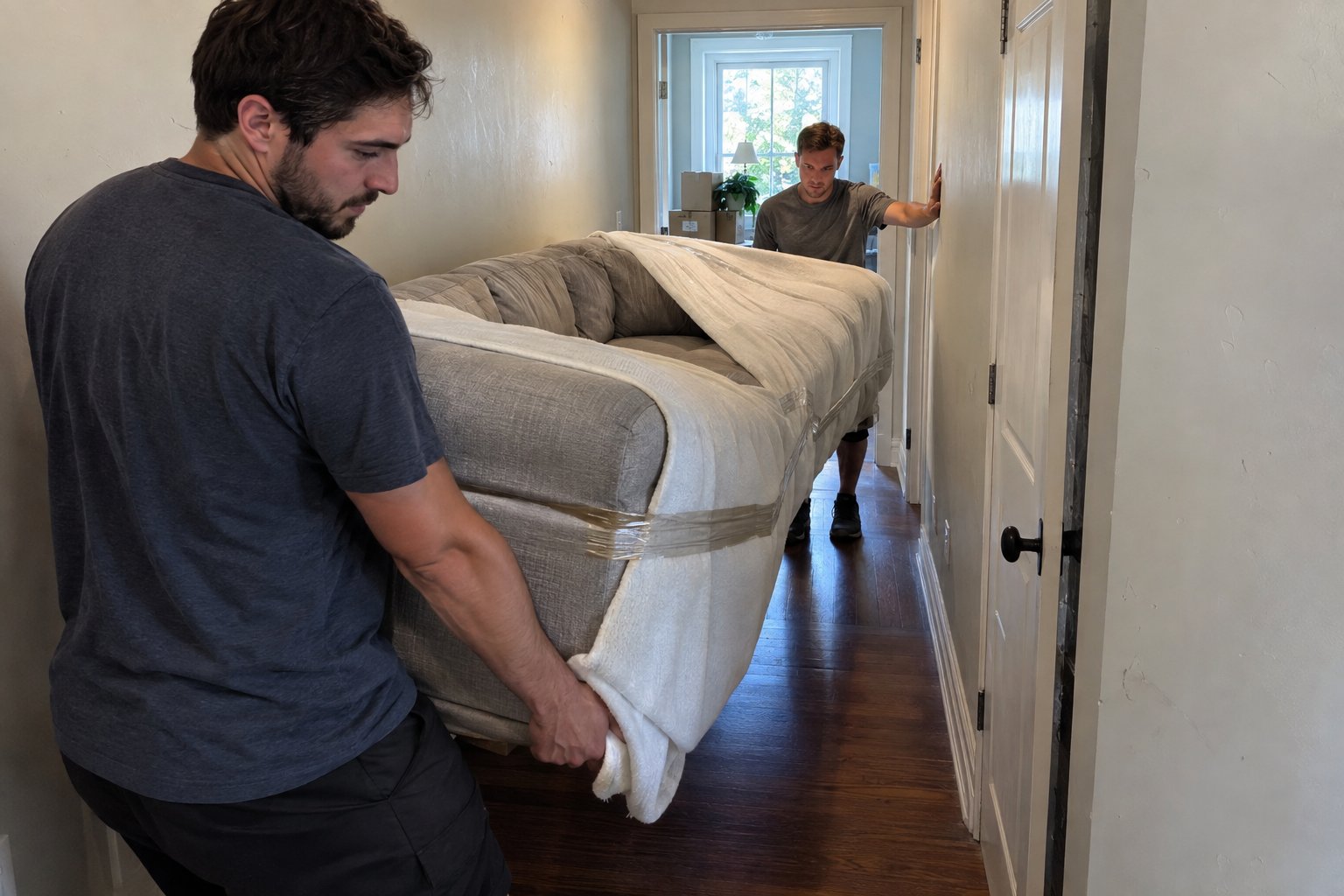
Wrap the entire couch in moving blankets — start with the arms, then the back, then the seat base. Use stretch wrap (plastic film) over the blankets to hold them in place. Do not use tape directly on upholstery or leather; adhesive residue is extremely difficult to remove from fabric and can permanently damage leather finishes. If you don't have moving blankets, large heavy-duty garbage bags or old bed sheets are a workable backup for shorter distances, though they provide far less padding than proper furniture pads.
For leather sofas specifically: before wrapping, check whether the leather is genuine or bonded. Bonded leather — a composite of leather scraps and polyurethane — is prone to cracking and peeling under any mechanical stress, including the friction of a moving blanket pulled tight. Bonded leather pieces should be wrapped loosely and handled with extra care.
Step 4: Execute the Carry With a Clear Plan
A couch should never be moved by one person — not even a loveseat if there are stairs involved. Two people is the minimum; three is better for anything over 200 pounds or going up or down stairs. Before the first lift, establish clear roles: who leads (walks backward, directs navigation), who follows (watches for obstacles, calls out clearances), and — on stairs — who manages the weight from below.
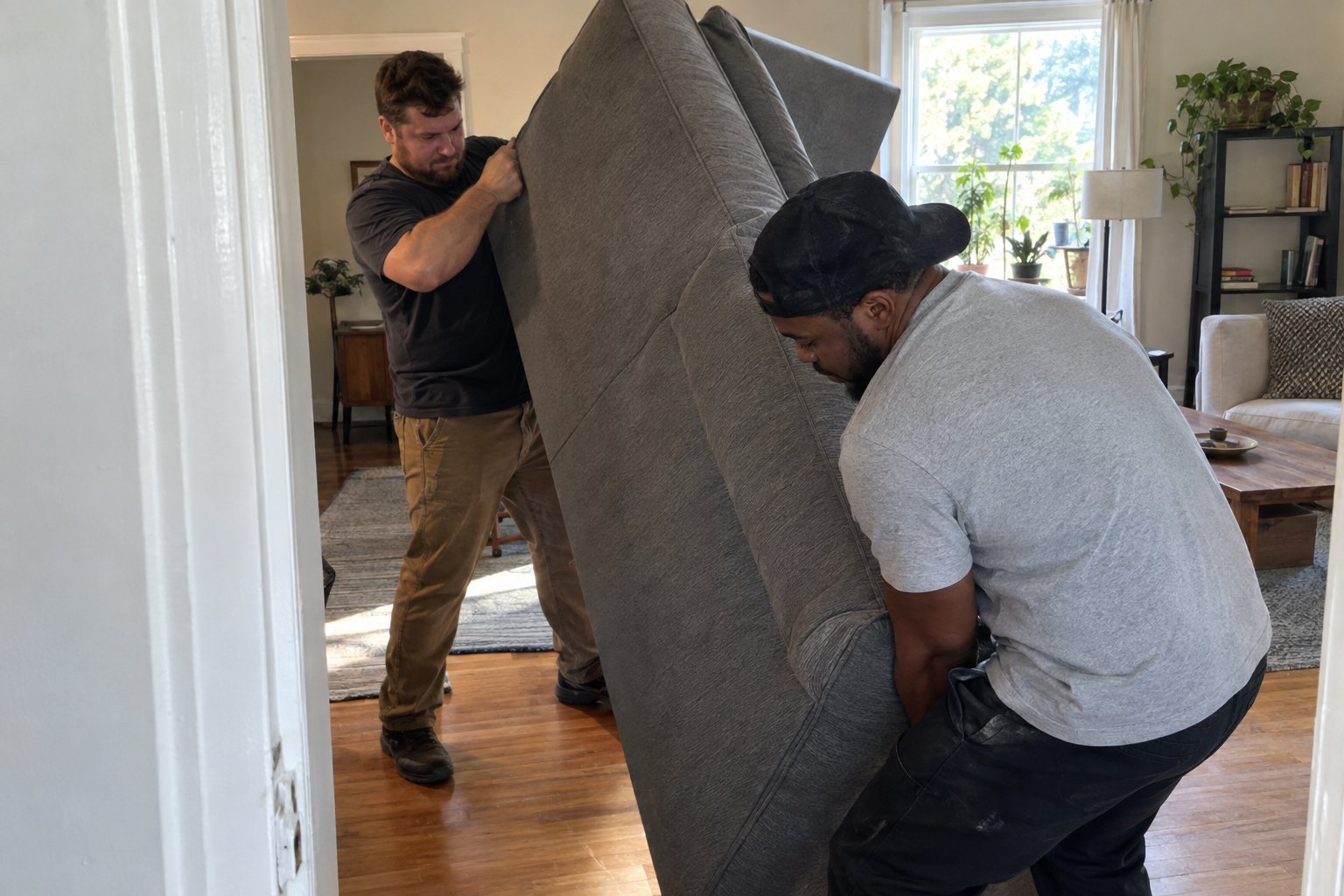
The standard technique for carrying a sofa through a doorway involves standing the couch on one end in an upright position, which transforms the footprint from a long horizontal rectangle into a narrower vertical one. Tip the couch so it stands on the back cushion rail (not the arm), confirm the height clears the door header, and walk it through with one person guiding from each side. This technique works on most standard sofas in most standard doorways. When it doesn't — usually because the diagonal measurement is too large — you'll need to do a more complex pivot maneuver, and that's when an extra set of hands becomes non-negotiable.
On stairs, move the couch with the heavy end (the base frame) going downstairs first, held by the stronger carrier. The carrier on the upstairs side bears less weight but controls speed and direction. Move one step at a time, communicate before every move, and never let the piece gain momentum downward. A couch that starts sliding on a staircase cannot be stopped by two people — it has to be controlled before it reaches that point.
When to Call Labor-Only Professionals Instead
Some couch moves are simply beyond what a DIY crew of two can execute safely. If your situation involves any of the following, calling a professional labor-only crew is the right call:
- A stairwell with a landing turn, low ceiling, or both
- A sectional sofa that cannot be separated into movable sections
- A sleeper sofa exceeding 250 pounds
- Doorways narrower than 30 inches where disassembly is not possible
- Elevator buildings where the elevator interior dimensions require specific positioning
- High-value upholstery (genuine leather, designer fabric, antique pieces) where damage risk is not acceptable
Labor-only moving services provide professional crews who bring the equipment — furniture dollies, moving blankets, straps, and pivot tools — and the experience to navigate tight spaces without damage. You supply the truck or container; they handle the lifting, maneuvering, and placement. For a piece as expensive and awkward as a large sofa, the cost of professional labor is almost always less than the cost of reupholstering a torn arm or replacing a cracked sectional frame.


FAQs
Start by measuring the couch's diagonal cross-section (height × depth with legs removed) and compare it to the doorway height. In most cases, tipping the couch upright on its back rail and walking it through vertically gives you the most clearance. If that still doesn't work, remove the door from its hinges (which adds 1–2 inches of clearance), and confirm whether any part of the frame or arms can be temporarily disassembled. If none of those options work, a professional crew with furniture-maneuvering experience may be needed — some moves genuinely require techniques that are difficult to execute without practice.
Yes, almost always. Most sofa legs unscrew by hand or with a flathead screwdriver. Removing them reduces the couch's height by 4 to 8 inches, which meaningfully improves clearance through doorways and when tipping the piece upright for maneuvering. Bag all legs and hardware together and tape them to the underside of the sofa frame so nothing gets lost in transit.
A standard three-seat fabric sofa typically weighs between 150 and 250 pounds. A sleeper sofa can exceed 300 pounds with the steel fold-out frame inside. Two people is the minimum for any couch move; three people is strongly recommended for sleeper sofas, sectionals, or any piece going up or down stairs. Moving a couch alone — even a smaller loveseat — significantly increases the risk of back injury and furniture damage.
Position the heavier base frame end going downstairs first, controlled by the stronger carrier. The person on the upstairs side holds the lighter back-rail end and controls direction. Move one step at a time, communicate clearly before each step, and keep the couch's weight centered — never let it gain downward momentum. Use furniture straps if possible to take some load off your hands and improve control. If the stairwell has a landing turn or low ceiling, consider hiring a professional labor crew, as those configurations require specific pivot techniques that are difficult to improvise safely.
Position the heavier base frame end going downstairs first, controlled by the stronger carrier. The person on the upstairs side holds the lighter back-rail end and controls direction. Move one step at a time, communicate clearly before each step, and keep the couch's weight centered — never let it gain downward momentum. Use furniture straps if possible to take some load off your hands and improve control. If the stairwell has a landing turn or low ceiling, consider hiring a professional labor crew, as those configurations require specific pivot techniques that are difficult to improvise safely.
Still have questions?
How to move with us?
Hit the “Get a Quote” button and tell us what you need.
Choose the service, date, and time that work best for you.
Our friendly team shows up on time and gets everything done safely.
Sit back while we take care of the rest.
.avif)