
How Much Does It Cost to Move a King-Size Bed?

Knowing how to move a king-size bed correctly is something most people don't think through until they're standing in the bedroom staring at a California king frame spread across 76 inches of floor space, with a padded headboard bolted to a slatted platform base, a mattress the size of a small raft, and a doorway that's exactly 32 inches wide. A king-size bed looks movable. It comes apart — sort of. It's furniture, not machinery. How hard could it be? The answer is: far harder than it appears, and the mistakes people make — skipping the disassembly, carrying slats loose, dragging the frame across hardwood, gripping the headboard by its upholstered panel — routinely result in snapped slats, bent side rails, gouged floors, cracked headboard corners, and at least one person walking backward down a stairwell with no idea what's at the bottom.
Need a professional crew to handle the heavy lifting so your king-size bed and bedroom furniture arrive without damage? Call 224-404-0069 or get a free labor-only moving quote from Lift & Load today.
Why Moving a King-Size Bed Is Harder Than It Looks
The first problem is sheer size. A standard king mattress measures 76 inches wide by 80 inches long. A California king runs 72 inches wide by 84 inches long. Neither fits through a standard doorway assembled, and neither can be angled or stood on end the way a twin or full mattress can without significant risk of damage or injury. The frame that supports it is often just as large — a full king platform base, with or without storage drawers, can span nearly the entire floor of a medium-sized bedroom and weigh well over 150 pounds as a unit.
The second problem is hardware complexity. Modern king beds are not simple four-post frames. Many have center support legs, drawer pedestals bolted to the side rails, under-bed storage systems, adjustable base compatibility, or upholstered panels attached with a combination of bolts, cam locks, and bracket clips. People who try to move a king bed without fully disassembling it first routinely snap a center support leg off the rail, shear a bolt at a bracket joint, or bend a side rail when the assembled frame flexes under its own weight during the carry.
The third problem is that the mattress and the frame require completely different handling strategies, and most people try to solve both problems at once. They leave the mattress on the frame, tip the whole assembly, and immediately understand why that doesn't work — the mattress slides, the frame twists, and someone gets pinned against a wall.
What You Need Before You Start
Getting a king-size bed out of a room without damage requires preparation, not just effort. Before you move anything, gather the following:
- A power drill or Allen wrench set — most bed frames use hex bolts, cam locks, or both. Know which tools your frame requires before you're on your knees trying to figure it out mid-move.
- Zip-lock bags or a small container for hardware — bolts, washers, slats pins, and leg caps disappear the moment you set them down. Bag and label everything by section.
- Moving blankets or furniture pads — side rails and headboards scratch easily and dent at corners. Wrap them before carrying.
- Mattress bag — a king mattress dragged across carpet or stood against a wall picks up tears, stains, and punctures fast. A disposable mattress bag costs a few dollars and prevents damage that can't be undone.
- Two or more people — a king mattress is not a one-person carry. Even if you can physically move it alone, doing so almost guarantees you'll damage the mattress, the walls, or yourself.
How to Disassemble a King-Size Bed Frame Correctly
Disassembly order matters. Working in the wrong sequence can trap components under the mattress or cause the frame to collapse before you're ready. Follow these steps in order.
Step 1: Strip the bedding completely
Remove all pillows, blankets, sheets, mattress toppers, and protectors. Pack them separately in bags or boxes. Don't leave anything on the mattress — even a pillow can catch on a door frame during the carry and pull your hands at the wrong moment.
Step 2: Remove the mattress first
Slide the mattress off the frame before doing anything else. With two people, one on each long side, grip the mattress from underneath along the edge and walk it upright. Stand it on its long edge against a wall in the room — not in the hallway, where it will block your path — and lean it at a slight angle with a blanket between it and the wall to prevent fabric abrasion. Once the mattress is out of the way, you have room to work on the frame.
Step 3: Remove the box spring or foundation (if applicable)
Not all king beds use a box spring, but if yours does, move it out of the room the same way as the mattress before touching the frame. A split king foundation — two twin XL box springs side by side — is significantly easier to carry than a single unit and should be moved one piece at a time.
Step 4: Pull out the slats
Most king platform beds use wooden slats that rest in a track along the interior of the side rails. Lift them out individually and bundle them together with rope, bungee cords, or packing tape wrapped around the bundle — not tape directly on the wood. Keep the center support beam or center rail separate if it's a distinct component. Label the bundle so you know which end is the head and which is the foot.
Step 5: Detach the headboard
Headboards are attached to the bed frame in several ways — through bolts at the top of the side rails, through a separate mounting bracket bolted to the wall, or through a combination of both. If the headboard is wall-mounted, disconnect the frame from the headboard first, then unmount the headboard separately. If it's frame-mounted only, unbolt it at the bracket connection points and have someone steady it as the last bolt comes out. Headboards — especially tall, upholstered panels — are top-heavy and will fall forward the moment the last fastener releases.
Step 6: Disassemble the frame rails
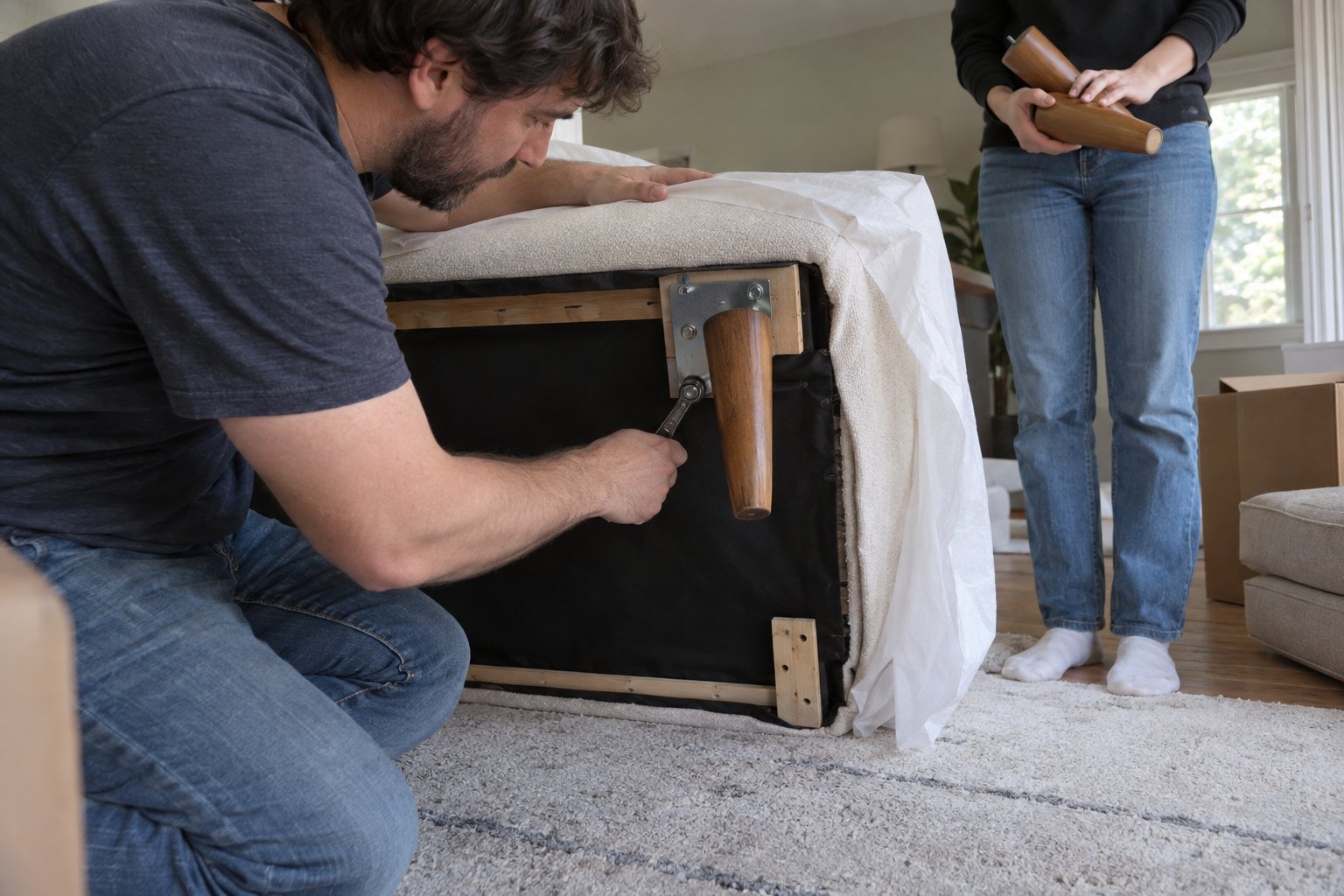
A standard king bed frame consists of two side rails, a headboard rail, and a footboard rail (if there is a footboard), connected by brackets and bolts. Disconnect the corners in sequence, working around the frame rather than removing opposite sides first. As each section comes apart, wrap it in a moving blanket and lean it against the wall. Don't stack metal rails on top of each other without padding — rail edges scratch and dent each other in ways that are obvious once the bed is reassembled.
How to Carry a King Mattress Through a Doorway
The mattress is the hardest single component to move, not because of weight alone — a king mattress typically weighs between 100 and 180 pounds depending on construction — but because of its size and flexibility. A king mattress carried upright through a doorway has to be maneuvered at an angle, and the sequence of that angle is something most people get wrong.
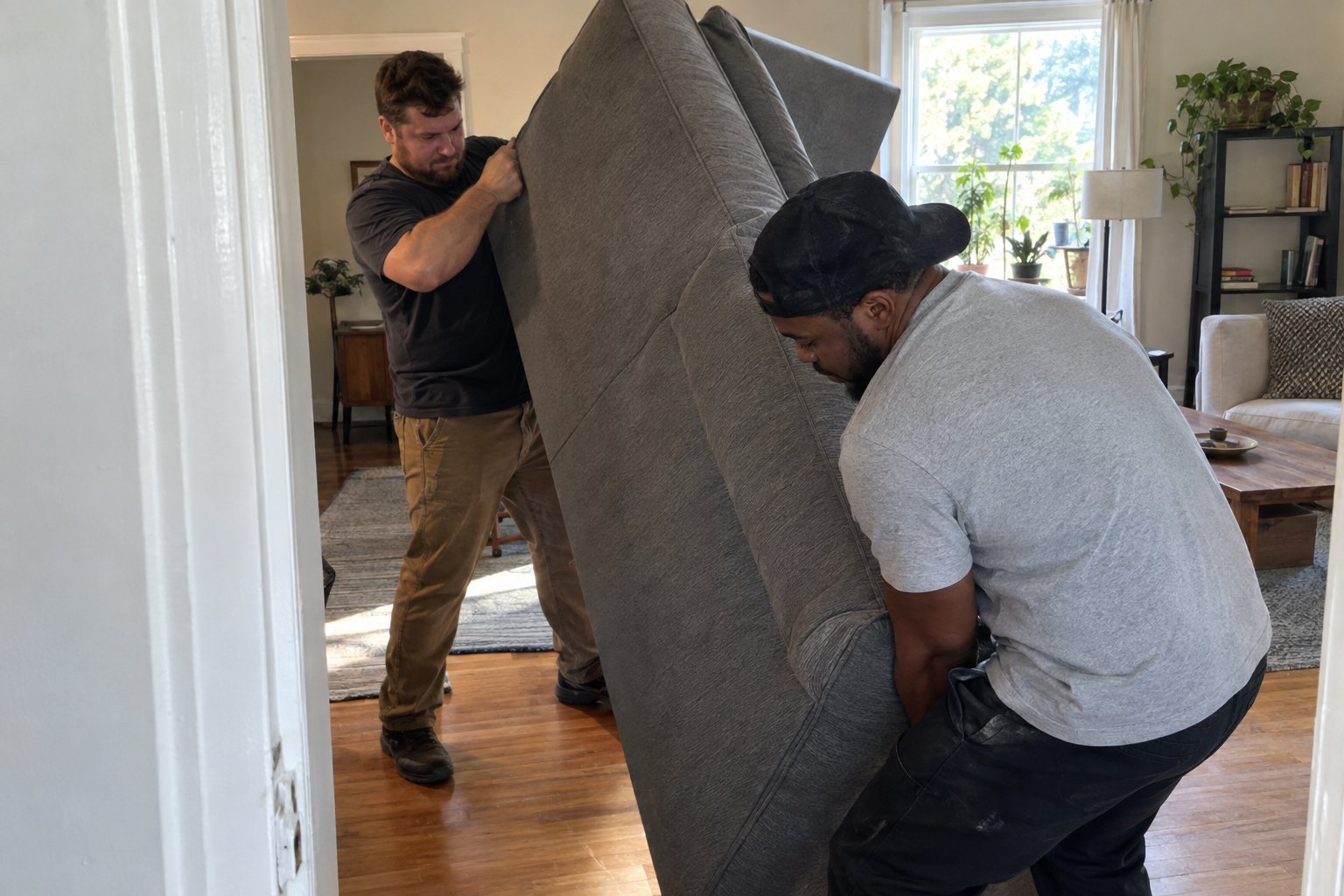
Start with the mattress standing vertically on its long edge. Approach the doorway from inside the room. As the leading edge passes through the doorway, begin rotating the mattress toward you at roughly a 45-degree angle, so the top edge leads and the bottom edge trails. One person guides the leading edge from the hallway side while the other manages the trailing edge from inside the room. Don't rush. Foam mattresses can compress slightly and recover, but coil mattresses and hybrid mattresses will not — forcing a coil king through a tight angle permanently damages the spring unit along the compressed edge.
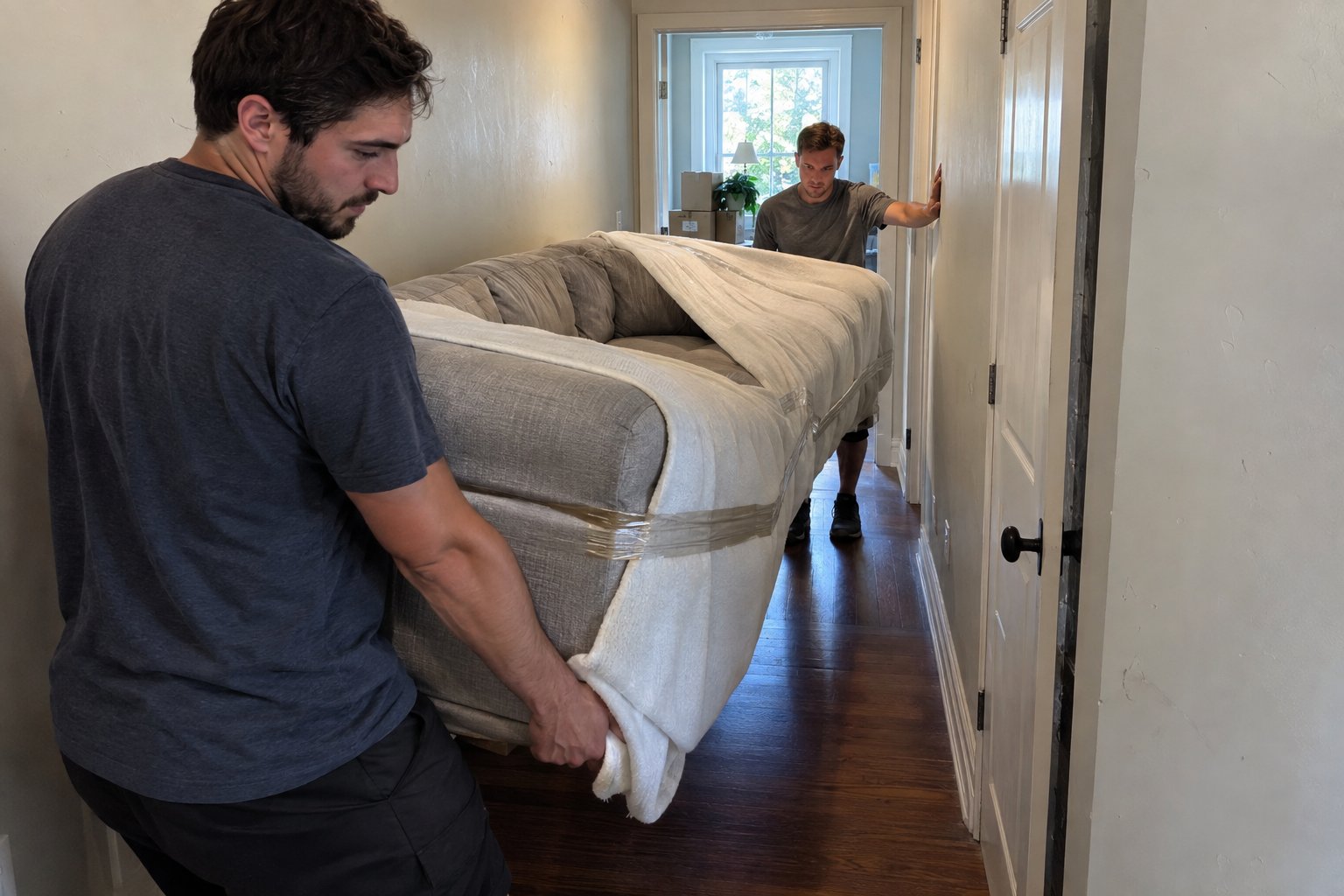
On stairs, always carry the mattress with the heavy end going down first. Assign one person to each side rather than one at the top and one at the bottom — a mattress carried with a person above and below it on stairs is a controlled fall waiting to happen if anyone loses grip.
Protecting Floors and Walls During the Move
A king bed frame in pieces is full of hard edges, exposed bolt ends, and unpadded metal brackets — every one of which is a potential gouge in your hardwood, scratch in your baseboard, or divot in your drywall. Protection takes five minutes and prevents damage that costs hundreds of dollars to repair.
- Lay moving blankets across high-traffic floor sections before you start carrying. Dragging anything across an unprotected hardwood floor — even briefly — leaves marks.
- Wrap all metal frame components in moving blankets or furniture pads before carrying them through the house. Pay special attention to the ends of side rails, which are the most likely to swing into a wall.
- Use door frame protectors or a thick folded blanket over each door frame when carrying the headboard through — particularly upholstered headboards, which snag on rough wood trim.
- Clear the path completely before the first carry. Pull rugs back. Move lamps and décor off the path. A rug bunching under a frame component being carried by two people is how ankles get turned.
Reassembling the King Bed at the Destination
Reassembly is easier than disassembly if you labeled your hardware and kept bolts bagged by section. Work in reverse order: set the side rails first, connect the corners, attach the headboard, install the center support, lay the slats in order from head to foot, set the foundation or box spring, and finally place the mattress. Hand-tighten all bolts before final-tightening — it's much easier to make positional adjustments when nothing is fully locked down yet. Once everything is in position, go around the frame and tighten each bolt in sequence rather than fully tightening each bolt before moving to the next.
Test the frame before placing the mattress by applying downward pressure at the center and at each corner. Any wobble, creak, or movement at a joint means a bolt is loose or a bracket is not fully seated. Find it now, not at 2 a.m.
If the whole process sounds like more than you want to manage on top of everything else a move involves, that's a reasonable conclusion. Get a free labor-only moving quote from Lift & Load — we handle the disassembly, the carry, and the reassembly so the bed is ready to sleep in on night one.



FAQs
Yes, in almost every case. A king-size bed frame assembled is too wide to fit through a standard 32-inch doorway and too unwieldy to carry safely without risk of bending rails or damaging walls. Fully disassembling the frame into its individual components — rails, headboard, slats, and center support — is the only reliable way to move it without damage.
Technically possible in some situations, but not recommended. A king mattress weighs between 100 and 180 pounds and measures 76 by 80 inches. Moving it solo through doorways and down stairs creates real injury risk and significantly increases the chance of mattress damage. Two people with a clear path and a mattress bag is the minimum safe setup.
Use zip-lock bags labeled by section — one bag for headboard bolts, one for side rail brackets, one for footboard hardware, and so on. Tape each bag to its corresponding frame piece with painter's tape, or keep all bags together in a single small container you carry with the frame components. Losing a single cam lock or bracket bolt can prevent full reassembly.
Often yes, especially for a king-size bed with a complex frame, drawers, or wall-mounted headboard. A labor-only crew handles disassembly, wrapping, carrying, and reassembly — which typically takes them a fraction of the time it takes most homeowners — without the full cost of a traditional moving company. If you have a truck or rental already, labor-only service covers exactly what's hardest about the move.
Often yes, especially for a king-size bed with a complex frame, drawers, or wall-mounted headboard. A labor-only crew handles disassembly, wrapping, carrying, and reassembly — which typically takes them a fraction of the time it takes most homeowners — without the full cost of a traditional moving company. If you have a truck or rental already, labor-only service covers exactly what's hardest about the move.
Still have questions?
How to move with us?
Hit the “Get a Quote” button and tell us what you need.
Choose the service, date, and time that work best for you.
Our friendly team shows up on time and gets everything done safely.
Sit back while we take care of the rest.
.avif)