
Piano on Stairs: What to Expect During a Safe Move
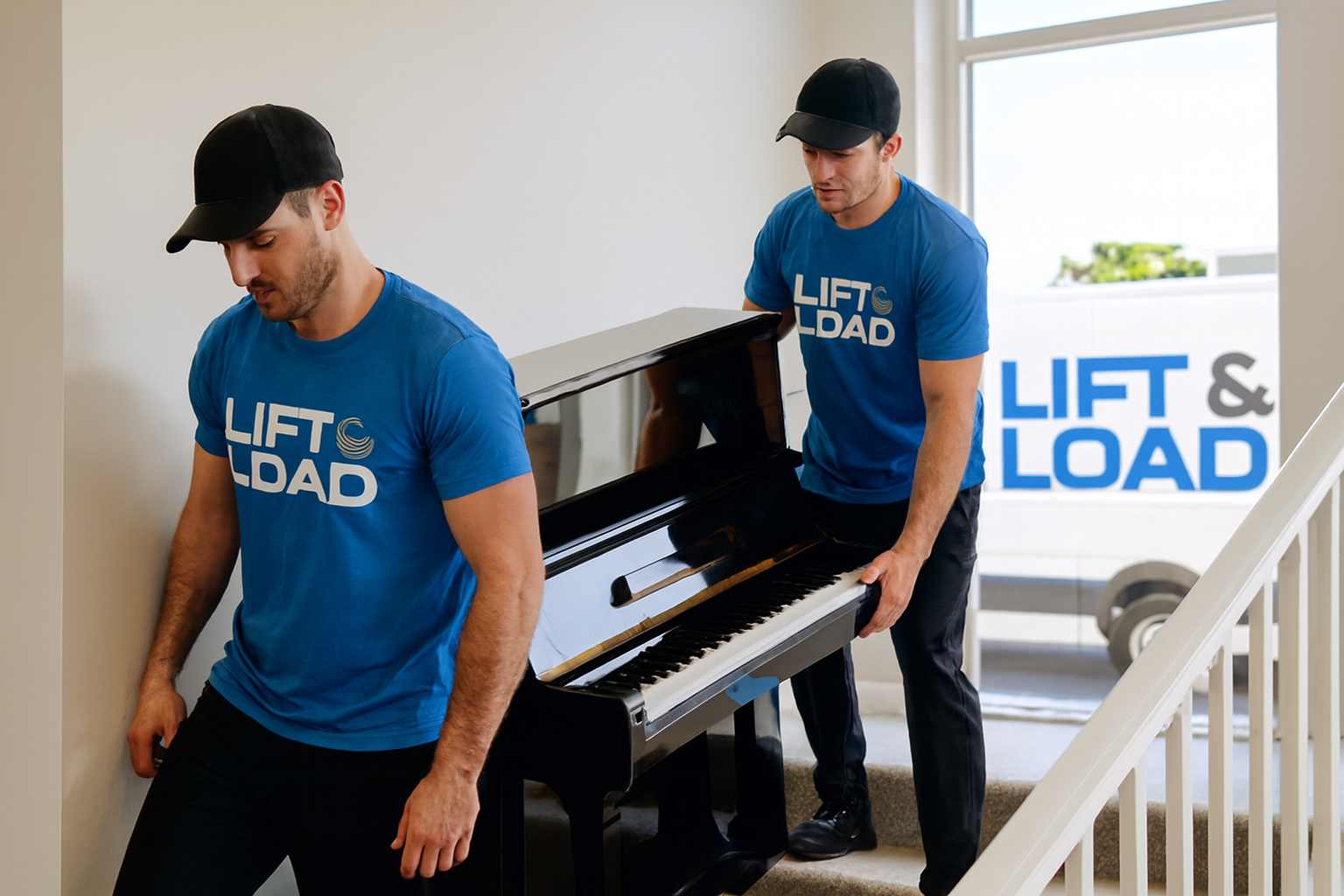
Knowing how to move a piano up or down stairs correctly is something most people don't think through until they're standing at the bottom of a staircase staring at a 600-pound upright that has lived against the living room wall for a decade — and realizing that the staircase is 36 inches wide, there's a 90-degree landing halfway up, the handrail is attached to the wall with two screws, and no single person in the room has any idea which end goes first. A piano looks like furniture. It has four legs. It has a flat back. How hard could it be? The answer is: harder than almost anything else you will ever try to move through a residential staircase, and the mistakes people make — trying to carry it upright, skipping the strapping step, putting too many people on the downhill side, underestimating the weight shift on the landing — routinely result in crushed feet, broken banisters, gouged hardwood, snapped legs, and a piano that arrives at the top of the stairs with a cracked soundboard and keys that will never play in tune again.
Need a professional crew to handle the heavy lifting so your piano makes it up or down the stairs without damage? Call 224-404-0069 or get a free labor-only moving quote from Lift & Load today.
Why Moving a Piano on Stairs Is More Dangerous Than Moving It Across a Room
The first problem is uncontrolled momentum. On a flat surface, a heavy piano on a dolly can be slowed and stopped with body weight and friction. On a staircase, gravity is working against you at every step. The moment the center of gravity shifts past the edge of a stair tread, the piano wants to go — fast, downward, and without any interest in whether your feet are in the way. Controlling that momentum requires proper technique, enough people in the right positions, and strapping that keeps the instrument attached to a stair dolly or piano board throughout the entire descent or ascent.
The second problem is the piano's own structure. Unlike a refrigerator or a chest of drawers, a piano is a precision instrument. The soundboard, bridges, strings, and action are calibrated to very tight tolerances. A hard impact — even one that doesn't visibly break anything — can shift the bridge, crack the soundboard, or knock the hammers out of alignment. You may not hear the damage until the tuner shows up three weeks later and tells you the instrument needs more than a standard tuning. Stairs create impact. Every tread is a controlled drop, and without the right equipment and technique, those drops add up.
The third problem is geometry. Most residential staircases were not designed with piano delivery in mind. Stair width, ceiling height on the landing, the angle of approach from the bottom, and the presence of a turn or winder step all affect whether a given piano can be moved on a dolly or must be carried — and carrying a piano by hand on stairs is where serious injuries happen. Getting the geometry right before you start, not while you're committed halfway up a flight, is what separates a successful move from an emergency room visit.
What You Need Before the Move Starts
Attempting to move a piano up or down stairs without the right equipment is not a technique problem — it is a preparation problem. Improvising with furniture pads and extra bodies does not substitute for tools built for this job.
Equipment that is non-negotiable
- A piano board or stair-climbing dolly — a flat, padded board with straps that secures the piano horizontally for stair transport; stair-climbing dollies have a stepped wheel configuration that allows controlled descent
- Moving straps rated for the weight — forearm forklifts or shoulder straps distribute the load across the body rather than concentrating it in the hands and lower back
- Moving blankets — wrap the entire exterior of the piano before it touches any equipment to protect the finish and the lid
- Non-slip gloves — piano lacquer and polyester finishes are slippery under stress; grip matters at every step
- A clear, empty staircase — rugs removed, handrail checked and tightened, nothing on any tread or landing that can shift underfoot
How many people you actually need
For an upright piano on a standard straight staircase, four people is the realistic minimum for a safe move: two handling the primary load, one spotting and guiding at the back, and one at the top or bottom controlling the dolly and managing the final placement. Fewer than four people on a stair move is not a challenge — it is a liability. A spinet or small console piano might be manageable with three strong, experienced movers, but anything full-size or larger requires a full crew and should not be attempted with whoever happened to show up that Saturday.
How to Move an Upright Piano Down Stairs: Step by Step
Going down is statistically riskier than going up. When a load shifts downward on a staircase, there is nothing stopping it except the people holding it. The technique below is for a standard upright piano being moved down a straight staircase with a piano board and adequate crew.
Step 1: Secure the lid and keyboard cover
Before the piano moves an inch, close and latch the keyboard lid. If it doesn't latch, tape it shut with moving tape applied over a moving blanket — never directly to the finish. Close the top lid as well and latch or tape it. Loose lids that swing open on a staircase can knock a mover off balance or slam shut on fingers at the worst possible moment.
Step 2: Wrap the piano completely
Lay moving blankets over the entire exterior — top, sides, back, and front — and secure them with stretch wrap or moving bands. The blankets protect the finish from contact with the stair wall, the door frame, and the equipment itself. They also give movers a non-slip surface to grip that isn't the lacquered wood panels.
Step 3: Tip the piano onto the piano board
A piano board is a padded flat board slightly longer than the piano is tall. The piano is tipped backward at a controlled angle (usually 30 to 45 degrees) and lowered onto the board, then strapped tightly in place. Two movers control the piano; one or two others manage the board and confirm the straps are seated. This step requires clear communication — no one moves until everyone is ready and the load is confirmed secure.
Step 4: Position movers correctly for the descent
The heaviest, strongest movers go on the downhill side — below the piano on the stairs. Their job is to control descent and resist gravity. The movers at the top guide and stabilize but do not bear the primary load going down. This positioning is counterintuitive, which is why untrained movers often get it backwards and lose control of the load.
Step 5: Move one stair tread at a time
There is no fast way to do this correctly. Each tread is a separate controlled move. The piano board is walked down one step at a time, with the downhill movers absorbing the weight and the uphill movers maintaining angle and preventing forward tip. On a landing or turn, the entire crew pauses, resets positioning, and confirms the new path before continuing. Rushing the landing is where most stair piano moves go wrong.
Step 6: Transfer to a flat dolly at the bottom
Once the piano reaches the bottom landing, tip it upright from the board and immediately onto a four-wheel furniture dolly or piano dolly for transport through the rest of the space. Do not carry it upright by hand across a room — roll it.
Going Up Stairs: What Changes
The physics reverse when you're going up, but the risks don't go away — they just change character. The danger going up is not a runaway load; it's a failed lift that drops the piano backward onto the movers at the bottom. The same four-person crew, the same piano board, and the same one-tread-at-a-time technique apply going up. The key difference is positioning: the strongest movers go at the top, pulling and guiding, while the movers at the bottom push and stabilize from below. On an ascent, the bottom movers are doing the hardest physical work, and they need clear sightlines and verbal confirmation at every tread.
When to Stop and Call a Professional Crew
There are situations where DIY stair piano moving is the wrong answer regardless of how prepared you are:
- A winding or spiral staircase — these cannot be navigated with a standard piano board and require rigging techniques that are outside the scope of amateur moving
- A grand or baby grand piano — these must be disassembled (legs, lyre, lid) before stair transport and reassembled at the destination; this is a specialty move that requires training and experience with the specific instrument
- Ceiling clearance of less than 80 inches on the landing — if the piano board can't clear the ceiling when the piano is at the angle required for the landing, the move cannot proceed safely without an alternate approach
- Fewer than four able-bodied movers available — this is not a situation to compensate for with extra effort; it is a reason to reschedule or hire help
- A vintage or high-value instrument — the replacement or repair cost of a Steinway, Bösendorfer, or similar instrument almost always exceeds the cost of hiring a specialty crew by a significant margin
If any of these conditions apply, the right move is to book a labor crew with experience in piano handling rather than attempt a move that has a high probability of damage or injury. Get a free labor-only quote from Lift & Load and have a crew handle it correctly the first time.
Protecting the Piano After the Move
Once the piano is at its new location, the job isn't quite done. Let the instrument acclimate to its new environment — temperature and humidity changes affect the soundboard, strings, and tuning pins — for at least two to four weeks before scheduling a tuning. Position it away from exterior walls, heating vents, air conditioning registers, and direct sunlight. Humidity swings are the leading cause of long-term piano damage, and a new home almost always means a new microclimate for the instrument. A piano technician can advise on humidity management if the new space is particularly dry or damp.
The stair move itself, when done correctly, should leave the piano structurally intact. If you hear buzzing, rattling, or notes that are dramatically out of pitch immediately after the move — not just slightly flat or sharp from normal transport — contact a piano technician before the next tuning appointment. Those symptoms can indicate a cracked bridge or shifted soundboard that needs assessment before further string tension is applied.




FAQs
Four people is the realistic minimum for a safe stair piano move: two handling the primary load, one spotting and guiding, and one managing the dolly or piano board and final placement. Fewer than four people on a stair move significantly increases the risk of injury and piano damage. For larger uprights or any grand piano, more experienced movers may be required.
You need a piano board or stair-climbing dolly to secure and transport the piano at the correct angle, moving straps rated for the piano's weight, moving blankets to protect the finish, non-slip gloves for grip, and a cleared staircase with the handrail checked and tightened. Improvising with standard furniture dollies and extra bodies is not a safe substitute for purpose-built piano transport equipment.
Going down is statistically riskier because gravity works against you — if the load shifts, there's nothing stopping it except the movers. Going up requires more physical effort, but a failed lift on ascent drops the piano backward onto the movers below rather than sending it forward. Both directions require the same crew size, equipment, and one-tread-at-a-time technique.
Allow the piano at least two to four weeks to acclimate to its new environment before scheduling a tuning. Temperature and humidity changes affect the soundboard, strings, and tuning pins. If you notice buzzing, rattling, or notes that are dramatically out of pitch immediately after the move — not just slightly flat or sharp from normal transport — contact a piano technician before tuning, as those symptoms may indicate structural issues that need assessment first.
Allow the piano at least two to four weeks to acclimate to its new environment before scheduling a tuning. Temperature and humidity changes affect the soundboard, strings, and tuning pins. If you notice buzzing, rattling, or notes that are dramatically out of pitch immediately after the move — not just slightly flat or sharp from normal transport — contact a piano technician before tuning, as those symptoms may indicate structural issues that need assessment first.
Still have questions?

How to move with us?
Hit the “Get a Quote” button and tell us what you need.
Choose the service, date, and time that work best for you.
Our friendly team shows up on time and gets everything done safely.
Sit back while we take care of the rest.
.avif)