
How to Move a Sectional Sofa: The Right Way to Disassemble, Maneuver, and Reassemble It

Knowing how to move a sectional sofa correctly is something most people don't figure out until they're standing in their living room looking at 140 inches of L-shaped upholstered furniture and a doorway that is, at best, 36 inches wide. A sectional sofa looks like it should be simple — it comes apart, right? Just separate the pieces and carry them out. But sectionals are among the most frustrating items to move in any home, and they account for more torn upholstery, scratched floors, and blocked staircases than almost anything else on a moving day. The pieces are heavy, the connection hardware is often hidden and fiddly, and the individual sections are still large enough to be awkward even after you've separated them.
Need a professional crew to handle the heavy lifting so your sectional arrives without damage? Call 224-404-0069 or get a free labor-only moving quote from Lift & Load today.
Why Moving a Sectional Sofa Is Harder Than It Looks
The first problem with sectionals is scale. A standard three- or four-piece sectional can span anywhere from 110 to over 160 inches across its longest dimension. Even separated into individual pieces, each section typically measures 35 to 45 inches wide and 35 to 40 inches deep — deep enough that carrying one upright through a 36-inch doorway requires precise angle control and a second person who knows exactly what they're doing.
The second problem is weight distribution. Sectional pieces are not uniform. The chaise section is longer and heavier on one end. The corner wedge piece is awkward and dense. The armless middle seat looks light but has a solid hardwood frame buried inside it. People routinely underestimate the weight of each individual section because they're comparing it to the full assembled unit — but a single chaise section can weigh 80 to 130 pounds depending on the frame material, foam density, and upholstery.
Then there's the upholstery itself. Fabric sectionals, in particular, are vulnerable to snags, scuffs, and compression marks. Dragging a section across a floor — even briefly — can pull fabric threads and leave permanent marks. Leaning a cushioned section against a rough wall or door frame can pill the fabric in a way that no amount of brushing will fix. Leather sectionals are slightly more forgiving of compression but are extremely vulnerable to scratches and crease marks if folded incorrectly or pressed against sharp edges.
Step 1: Understand How Your Sectional Connects Before You Start
Not all sectionals separate the same way, and trying to pull pieces apart without understanding the connection mechanism is a reliable way to damage both the connector hardware and the upholstery around it.
Common Connection Types
The most common sectional connectors are metal hook-and-bracket systems — a hook mounted on one section drops into a slot on the adjacent section, pulling the pieces flush. To separate these, you lift one section slightly and slide it laterally to disengage the hook before pulling apart. Do not try to yank sections straight apart without lifting first; you will tear the bracket out of the frame.
Some sectionals use a pin-and-clip system, where a metal rod inserts vertically into aligned holes on the two mating sections. These usually require you to reach under the furniture and press a release clip before the pin can be withdrawn. A flashlight is helpful here — these clips are rarely visible without one.
A smaller number of sectionals — particularly older units and some higher-end brands — are joined with bolts that run through the frame. These require a socket wrench or hex key to disassemble. Check your original assembly manual if you have it, or look up the manufacturer's model number online. Attempting to separate a bolted sectional by force will crack the frame.
Locate Every Connection Point
Most sectionals have two connection points per joint — one near the front of the seating area and one near the back. Some three- or four-piece units have additional connectors at the floor rail. Before separating any two pieces, feel along the inside junction of the join for every connector and release them all. Leaving even one engaged is enough to split the surrounding fabric when you try to pull the sections apart.
Step 2: Strip the Sectional Down Before You Move Anything
Reducing the weight and profile of each section before the carry is not optional — it's how you protect both the furniture and the people moving it.
Remove All Cushions
Seat cushions, back cushions, bolsters, and throw pillows all come off before any section is moved. Cushions add weight and shift the center of gravity unpredictably during a carry. They also get compressed and misshapen when a section is tilted on its end — and on sectionals with attached back cushions, that compression can be permanent.
Once removed, keep cushions together as a set and label which section they came from. Foam densities and cushion profiles often vary between sections, and mixing them up during reassembly means a sofa that looks right but never sits correctly.
Remove the Legs
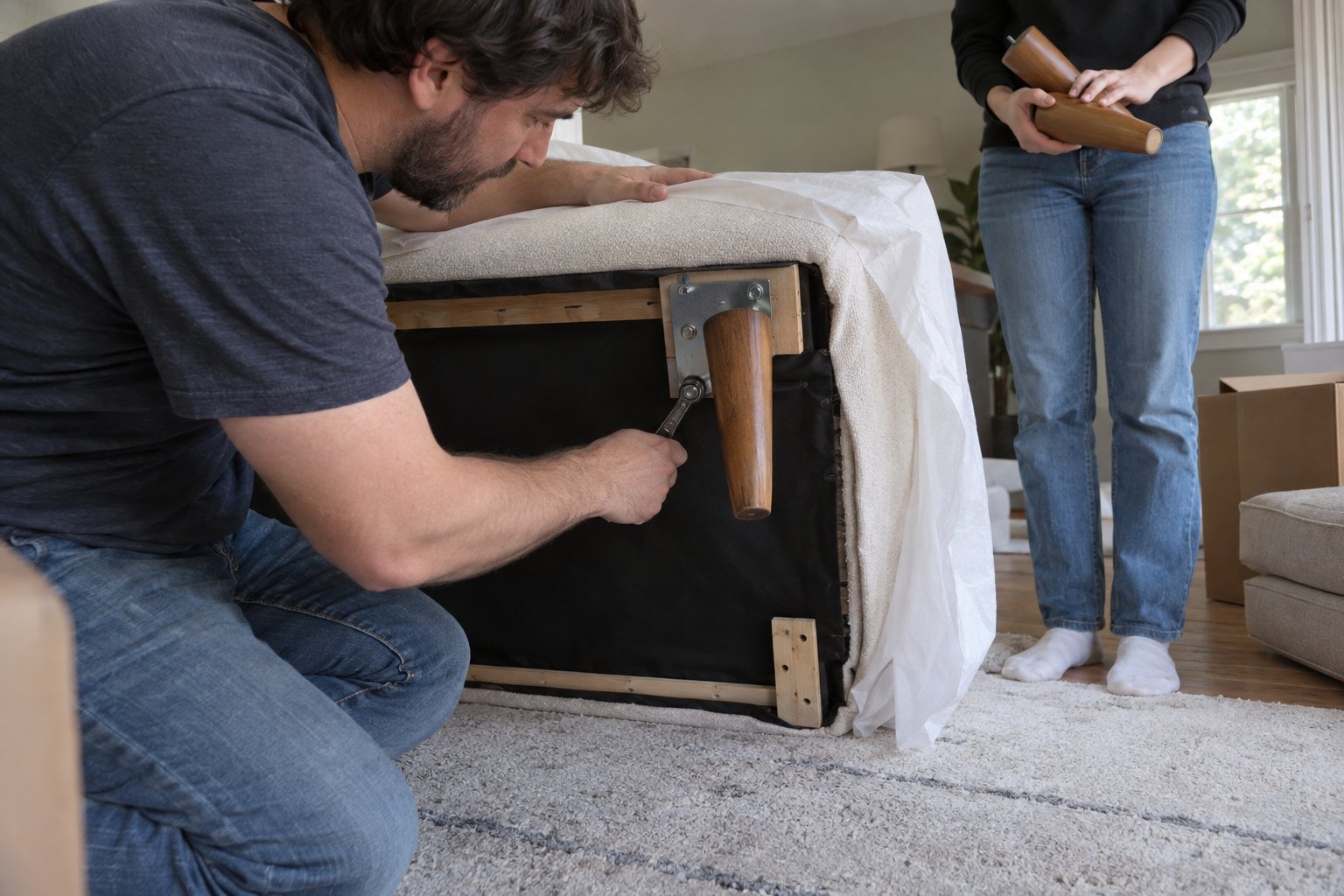
Most sectional legs unscrew directly from the bottom of the frame — usually a quarter-turn to disengage, or a full rotation for threaded legs. Removing the legs accomplishes two things: it reduces the height of each section by three to six inches (which can make the difference between fitting through a doorway or not), and it eliminates the most common source of floor gouging during a move. Put the legs and their hardware in a labeled zip-lock bag taped to the section they came from.
Step 3: Measure and Plan the Route
Every section needs its own clearance check before you carry it. Measure the height, width, and depth of each separated section. Then measure every doorway, hallway width, staircase width, and ceiling height on the route from the current location to the truck.
Calculate the Diagonal
The number that matters most is the diagonal measurement of each section — the distance from one corner to the opposite corner. A section that is 38 inches wide and 36 inches deep has a diagonal of approximately 52 inches. A standard doorway is 80 inches tall. That means you have just under 28 inches of clearance when you tilt the section on its side to angle it through the door. If the hallway on the other side is less than 52 inches wide, you cannot tilt the section that way — you'll need to go through the doorway feet-first and rotate inside the room or hallway.
Map every turn. Staircases with landings are the most common bottleneck. Walk the full route with your tape measure before you touch a single section.
Step 4: Protect the Upholstery for the Move
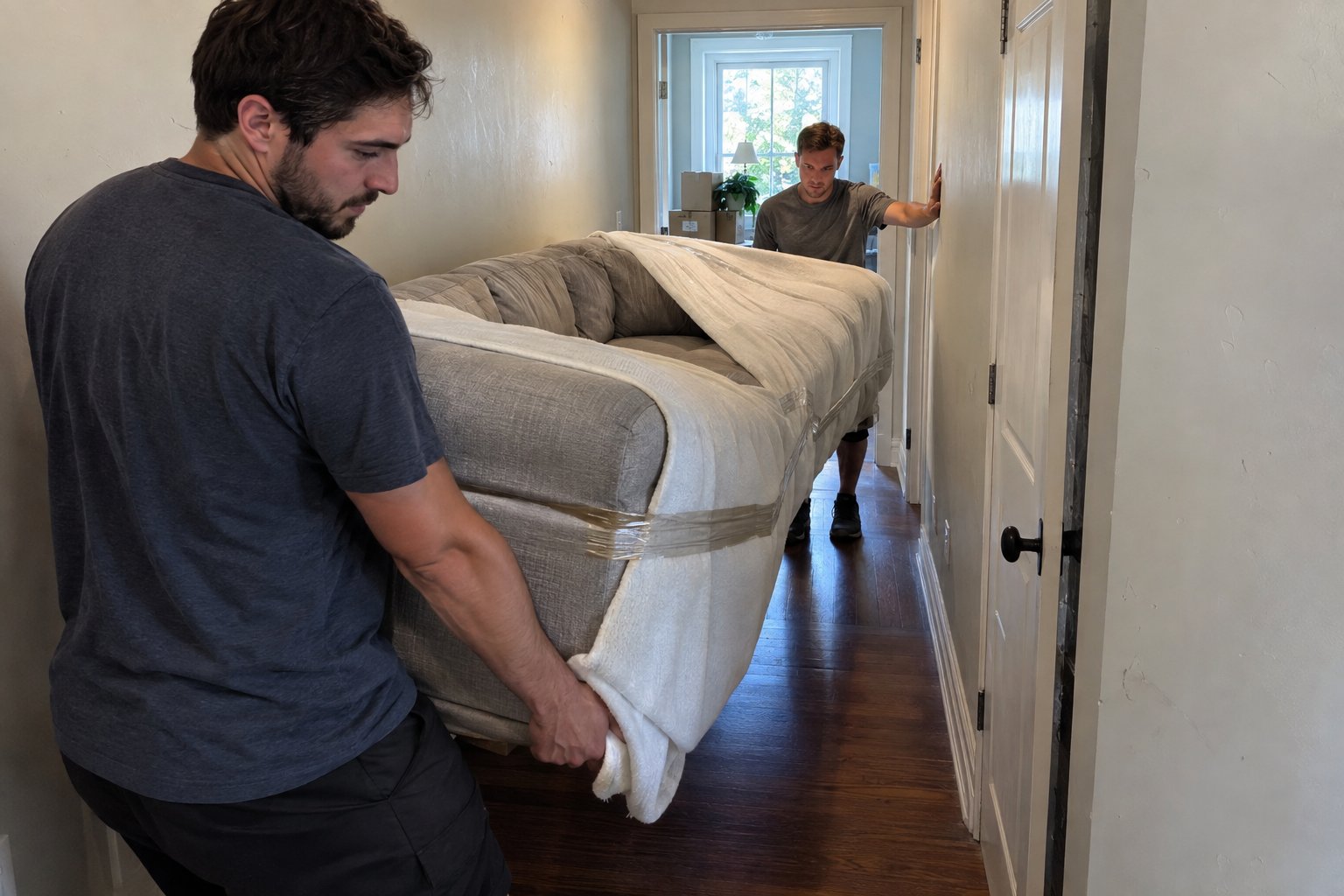
Once the sections are separated and stripped, wrap each one before it leaves the room. Moving blankets are the right tool for sectional pieces — they're thick enough to absorb impact against door frames and wall corners, and they wrap securely with packing tape applied only to the blanket (never directly to upholstery).
For fabric sectionals, pay extra attention to the corners and armrests, which are the first surfaces to snag on door frames. Wrap these areas with at least two layers of moving blanket before securing. For leather sectionals, never use tape of any kind near the surface — use rubber bands or blanket clips to hold wrapping in place. Tape adhesive will lift a leather surface finish even through the blanket if it contacts the material.
Protecting the Floor During the Move
Place moving blankets or floor runners along the carry path before you start. Sectional sections are heavy and awkward, and even careful movers will momentarily rest a piece on the floor. A bare hardwood or tile floor can scratch permanently from a single contact with a bare sectional frame. Having floor protection down before the first section moves is the right order of operations, not an afterthought.
Step 5: Carry Each Section Correctly
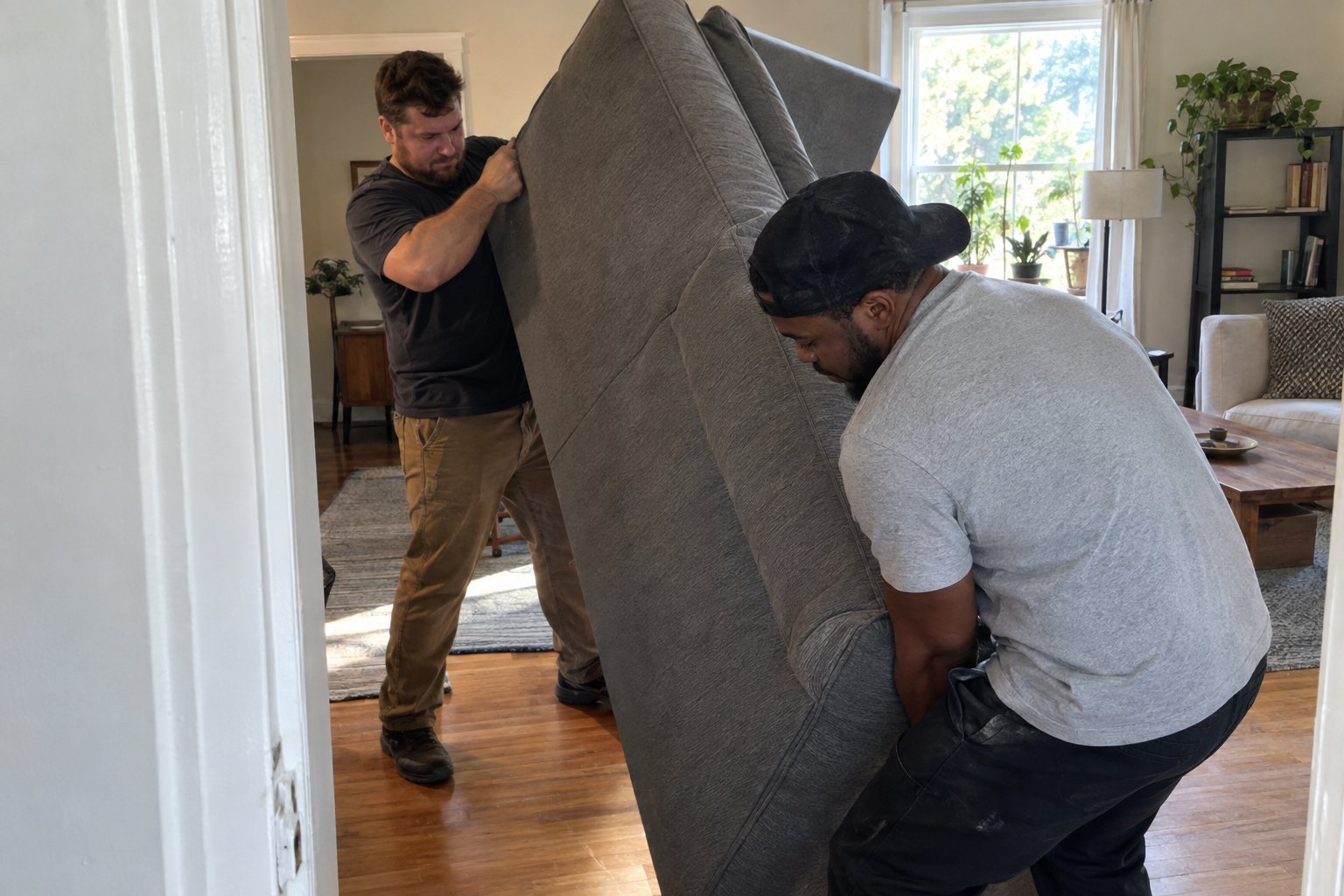
Two people are the minimum for any individual sectional section. Three is better for chaise sections and corner pieces, which tend to be longer and more ungainly. The carry technique is the same as with any large furniture: bent knees, straight back, elbows in, and communication between carriers before every change in direction.
Most sectional sections travel best on their side — turned so the seat faces the wall, with one person at each end. This reduces the carrying height and centers the weight. The exception is the chaise: a long chaise section carried on its side wants to sag in the middle, which can bend and crack the frame. Chaises generally travel better upright with one carrier at the base and one at the back, or with a furniture dolly under the base end.
Through doorways, the person at the leading end calls the angle adjustments. Take it slow. Frame corners against a door jamb is the most common source of damage during a sectional move, and it happens in a fraction of a second.
Step 6: Reassemble in the New Space
Before you connect any sections, place all pieces where you want them and do a dry layout of the configuration. Sectionals are heavy enough that rearranging them after connection is its own ordeal. Confirm the orientation, the traffic flow, and the connection points are aligned before you lock anything in.
Reattach legs before connecting sections to each other — it's easier to adjust individual pieces when they're independently mobile. Once legs are on, align the connection hardware carefully and engage connectors in the reverse order of disassembly. Confirm every connection point is fully seated before putting cushions back on. A sectional with a partially engaged hook will slowly pull apart under normal use until the joint fails entirely.
Don't want to manage any of this yourself? Get a free labor-only moving quote from Lift & Load — our crews handle sectionals regularly and know every connection type.



FAQs
In most cases, yes. Even a two-piece sectional, when fully assembled, is too wide and long to fit through standard doorways and navigate hallway turns. Separating the sections is almost always necessary, and it also makes each piece safer and easier to carry. The only exception is a very small two-piece sectional in a home with wide double-door openings — and even then, it's usually easier to separate it than to attempt a difficult carry.
The most reliable method is to look up the brand and model number — most manufacturers publish assembly guides online. If you no longer have that information, feel along the inside junction between two sections with your hand. Hook-and-bracket systems have a distinct metal-on-metal feel and a small gap near the top or bottom of the join. Pin systems have a small access hole you can feel with a finger. Bolted frames will have visible hardware or covered bolt holes along the mating faces of the sections.
Not safely, and not without a high risk of damaging the furniture or injuring yourself. Even the lightest sectional sections — typically armless middle seats — weigh 50 to 80 pounds and are awkward enough to carry that controlling them alone through a doorway is genuinely difficult. Chaise sections and corner pieces should always have at least two people, and three is better for anything over 90 pounds or longer than 65 inches.
If separated and stripped sections still won't clear a doorway, you have a few options. First, remove the door from its hinges — this typically adds 1.5 to 2 inches of usable width and is quick to do with a screwdriver and hammer. Second, check whether removing the door trim (casing) adds enough clearance; this is a more involved step but sometimes necessary. If neither option works, the section may need to be moved through a window or a sliding glass door if one is accessible. In rare cases — typically with large sectionals that were delivered before other renovations narrowed the space — professional disassembly of the frame itself is the only solution.
If separated and stripped sections still won't clear a doorway, you have a few options. First, remove the door from its hinges — this typically adds 1.5 to 2 inches of usable width and is quick to do with a screwdriver and hammer. Second, check whether removing the door trim (casing) adds enough clearance; this is a more involved step but sometimes necessary. If neither option works, the section may need to be moved through a window or a sliding glass door if one is accessible. In rare cases — typically with large sectionals that were delivered before other renovations narrowed the space — professional disassembly of the frame itself is the only solution.
Still have questions?
How to move with us?
Hit the “Get a Quote” button and tell us what you need.
Choose the service, date, and time that work best for you.
Our friendly team shows up on time and gets everything done safely.
Sit back while we take care of the rest.
.avif)