
Sofa Bed Moving Checklist: Fold, Disassemble, and Load It

Knowing how to move a sofa bed correctly is something most people don't think through until they're standing in the living room staring at a piece that's part couch, part steel-framed pull-out bed, and entirely unwilling to go anywhere without a fight. A sofa bed looks like a couch. It sits like a couch. It has couch cushions. How hard could it be? The answer is: far harder than almost any other piece of furniture in the house, and the mistakes people make — attempting to carry it assembled, forgetting to fold and latch the mattress, gripping the arm upholstery instead of the frame — routinely result in broken hinges, bent metal bars, gouged hardwood floors, torn door frames, and at least two people trying to figure out why it won't fit around a corner that seems more than wide enough.
Need a professional crew to handle the heavy lifting so your sofa bed and furniture arrive without damage? Call 224-404-0069 or get a free labor-only moving quote from Lift & Load today.
Why Moving a Sofa Bed Is Harder Than It Looks
The first problem is weight. A standard pull-out sofa bed — the kind with a folding steel mattress platform hidden inside — typically weighs between 200 and 350 pounds depending on the size and materials. A queen sleeper sofa can push past 300 pounds without a single modification. That's not couch weight. That's approaching piano weight, and it's distributed across a piece that has no obvious grip points, a low center of gravity, and a steel mechanism that adds mass right where the frame is most awkward to hold.
The second problem is geometry. A sofa bed is wider and deeper than a standard sofa because it has to accommodate a fold-out mattress frame inside its base. That extra depth is exactly what kills you in hallways, on landings, and around corners. What looks like a workable path with a regular couch becomes impossible with a sleeper because the piece simply won't pivot the way you need it to. People who've successfully moved full-size sofas through tight spaces are routinely surprised when the sofa bed won't follow the same path.
The third problem is the internal mechanism. The folding steel frame inside a pull-out sofa is held in place by a series of hinges, cross bars, and latch points that are not designed to absorb lateral stress. When people carry a sleeper sofa without properly securing the interior mattress platform, the mechanism shifts with every step, puts stress on the hinges at the worst moments, and occasionally unfolds partway — transforming a difficult carry into a genuinely dangerous one.
What You Need Before You Start
Moving a sofa bed safely requires preparation that goes well beyond what a regular couch demands. Before you lift anything, make sure you have the following in place:
- At least three people — a sofa bed is not a two-person carry for most of its journey. You need a third person for stairs, tight turns, and any moment where the piece needs to be tilted and controlled at the same time.
- Moving straps or a furniture dolly — straps distribute the weight across shoulders and reduce the strain on wrists and lower backs during long carries. A furniture dolly is essential for moving across flat floors before you reach stairs.
- Rope, bungee cord, or packing tape — you need to secure the interior mattress platform in the closed position before lifting. Without this, the mechanism can shift or partially open mid-carry.
- Moving blankets or furniture pads — sofa beds have exposed wooden arms and upholstered panels that scratch, scuff, and tear against door frames without protection.
- A tape measure — measure the sofa bed's width, height, and depth in both the closed and tilted positions, then measure every doorway, hallway width, and stairwell landing on the exit path. Do this before moving the piece an inch.
How to Prepare a Sofa Bed for Moving
Preparation is not optional with a sofa bed. The steps below apply to nearly every pull-out sleeper configuration, from basic innerspring mattress units to newer memory foam fold-out designs.
Step 1: Remove the Mattress If Possible
Many pull-out sofa beds have a mattress that can be detached from the fold-out steel platform. Open the sofa fully, inspect the connection points between the mattress and the steel frame, and determine whether the mattress lifts off or is permanently fastened. If it lifts free, remove it, roll it or fold it, and bag it separately. This alone can reduce the sofa's moving weight by 40 to 80 pounds and significantly improve balance during the carry.
Step 2: Fold and Secure the Interior Frame
Close the sofa bed fully and verify that the mechanism has latched. On most pull-out sofas, there's a physical latch or catch point that locks the frame in the closed position. If yours doesn't have one — or if the latch is worn and unreliable — use rope or strong bungee cords looped underneath the sofa frame and over the top of the cushion deck to hold the mechanism firmly closed. Do not skip this step. A partially open sleeper mechanism during a stairwell carry is a serious injury risk.
Step 3: Remove Cushions and Legs
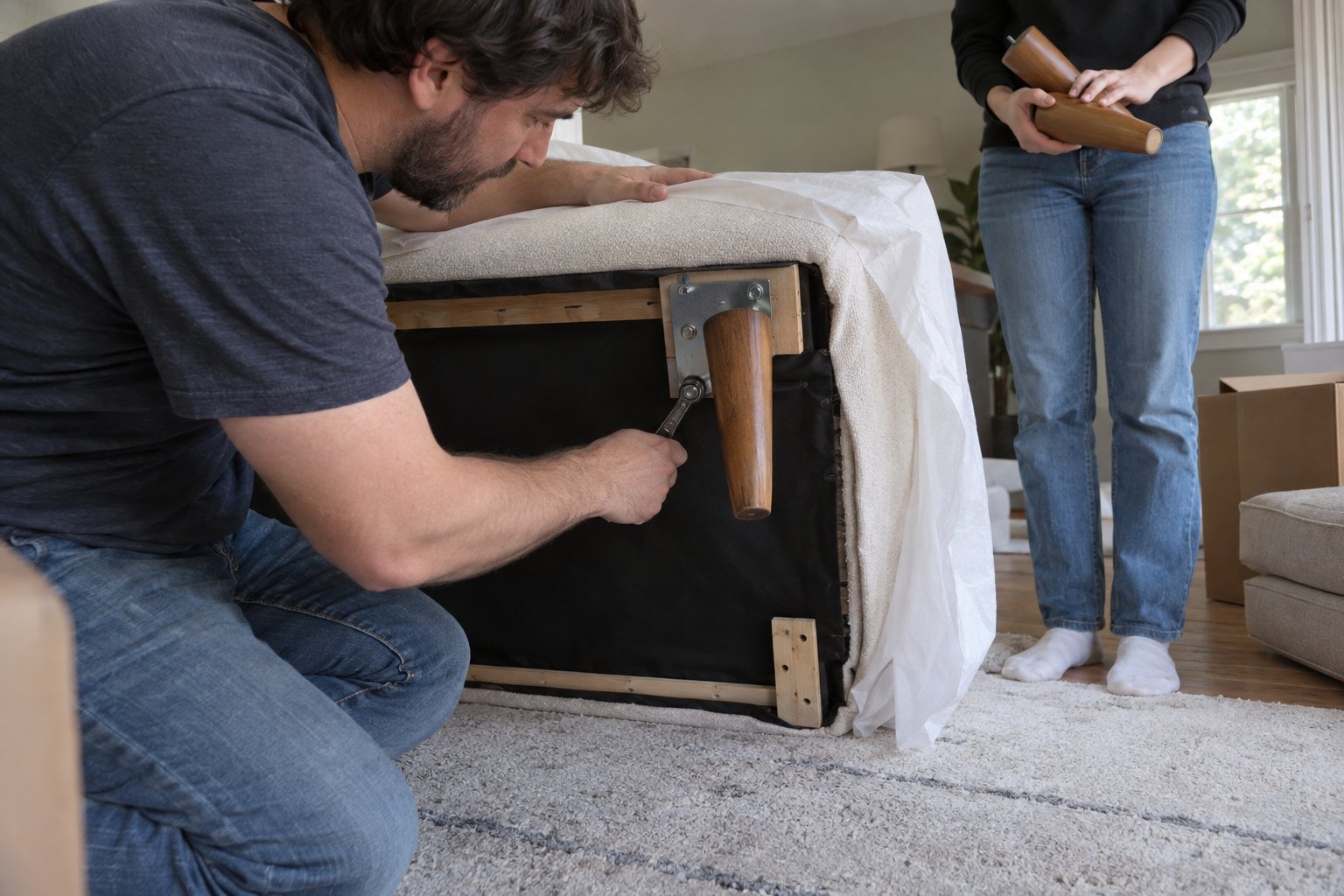
Pull off all seat and back cushions and move them separately. Check whether the sofa's legs unscrew — many do, and removing them reduces the overall height by several inches, which can make the difference between fitting under a low ceiling on a stairwell or not. Bag any removed legs and hardware together and keep them with the piece.
Step 4: Wrap and Pad the Piece
Wrap the arms and any exposed wooden components in moving blankets secured with packing tape or rubber bands. Pay particular attention to the corners of the arms and the top back rail — these are the points most likely to make contact with door frames during a carry. Do not tape directly to upholstery fabric; tape only to the moving blanket.
How to Move a Sofa Bed Through Tight Spaces
The carry itself is where most sofa bed moves go wrong, and it almost always happens in one of three places: the first doorway out of the room, the hallway turn, or the stairwell. Each requires a slightly different approach.
Through a Doorway
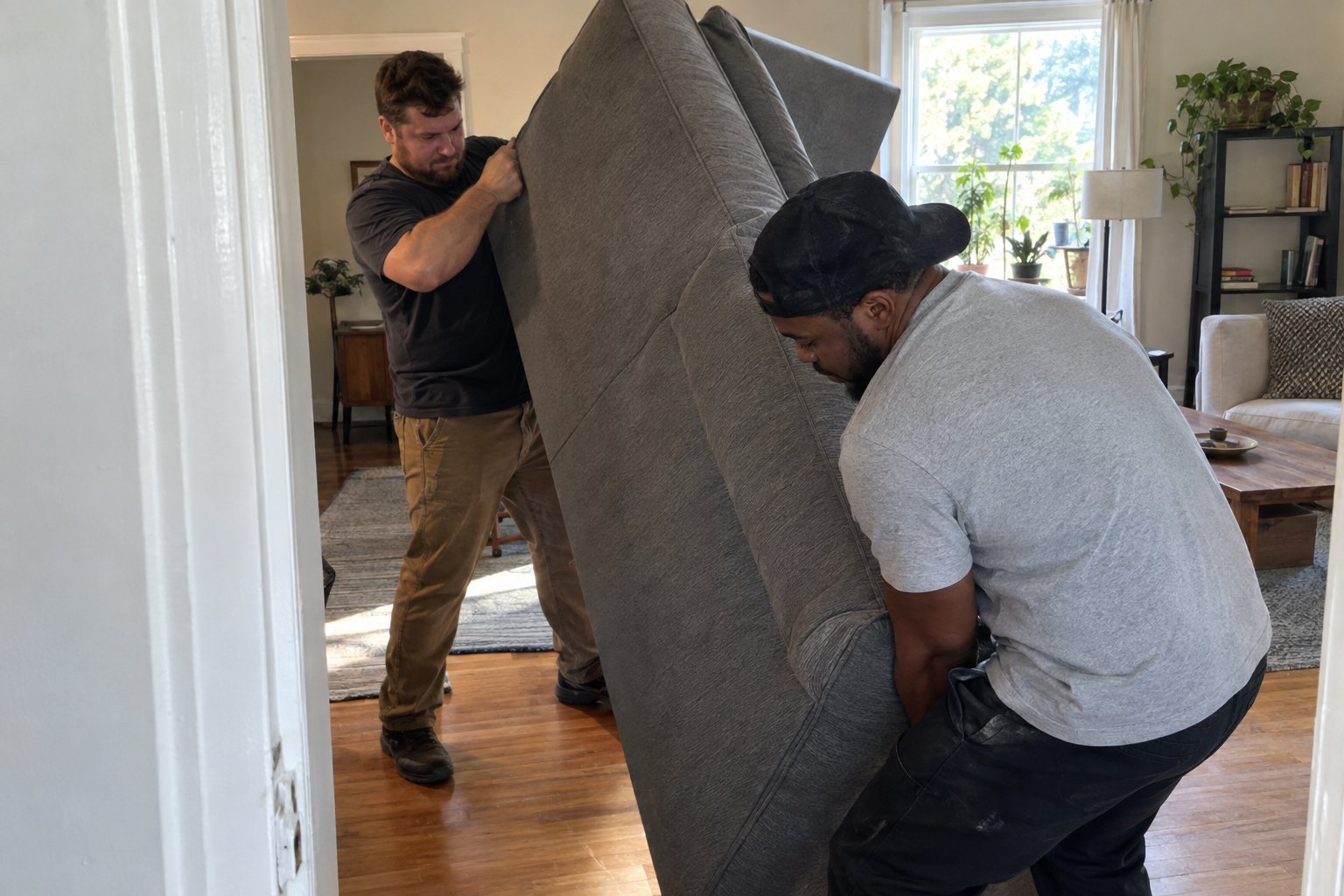
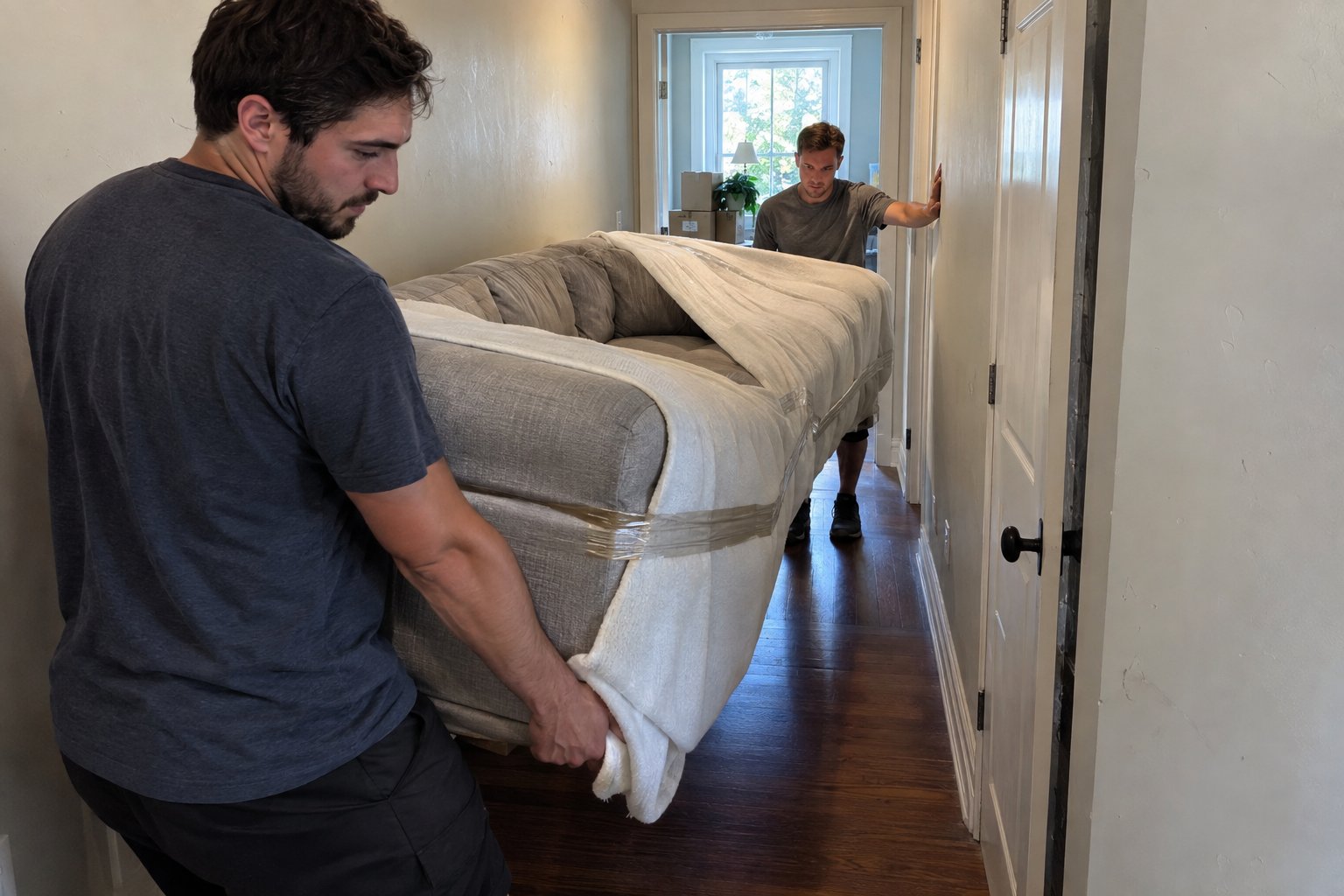
Measure the door opening against the sofa's height and depth. A sofa bed that won't clear a doorway upright may clear it when tilted — standing the piece on one arm with the back panel facing through the opening first. This is called the "L-turn" or "doorway pivot" and it works well when you have enough ceiling height to allow the tilt. Designate one person as the guide inside the room and one as the receiver outside, with the third stabilizing the weight during the tilt.
Around a Hallway Corner
Sofa beds often won't pivot around a hallway corner the way a standard couch does because the extra depth prevents the rear from clearing the inner wall. If your path includes a 90-degree turn in a hallway, measure the hallway width plus the door opening on the far side and run the numbers before committing to that path. In some cases, moving the piece out through a different exit — a sliding door, a garage, a ground-floor window — is genuinely faster and safer than forcing a corner that won't work.
Down Stairs
Stairs are where sofa bed moves become dangerous if the crew is under-prepared. The person at the bottom bears the majority of the weight and is working in the most constrained position. Use moving straps whenever possible. Move one step at a time with a deliberate pause between each to check grip, footing, and control. Never rush a stair carry on a piece this heavy.
Common Mistakes to Avoid When Moving a Sofa Bed
Even experienced movers make predictable errors with sofa beds. Knowing what to watch for prevents the most common damage scenarios:
- Not measuring first. Sofa beds that can't fit through the planned exit path are one of the most common labor-only job complications. Measure everything before you move the piece off the wall.
- Lifting from the cushion deck. The cushion platform on most sleeper sofas is not a structural grip point. Lift from the base frame and arm structure, not from the top surface where the mechanism lives.
- Forgetting the mattress weight. If you didn't remove the mattress before carrying, the piece is heavier than it looks. Adjust your team size accordingly.
- Dragging instead of lifting. Sofa beds have base frames that catch on carpet edges, floor transitions, and thresholds. Even a short drag can bend the base frame or tear the bottom fabric cover. Always lift fully before moving forward.
- Underestimating the stairwell. A sofa bed that weighs 250 pounds and requires three people to carry on a flat surface requires at minimum three people — and ideally a fourth as a spotter — on stairs.
When to Call a Labor-Only Moving Crew
A sofa bed is one of the pieces where the calculation between DIY and professional labor tips most clearly toward getting help. The weight is in a range where injury risk is real. The geometry is in a range where property damage is likely without experience. And the mechanism adds a variable that most people have never dealt with before.
A labor-only moving crew handles the carry, the stair navigation, the doorway pivots, and the truck loading — while you focus on everything else the move requires. You rent the truck, you pack the boxes, and the crew handles the pieces that can hurt you or your home if they're moved wrong. For a sofa bed, that division of labor is almost always worth it.
If you're weighing the options, call 224-404-0069. Lift & Load provides labor-only moving services with crews that know exactly how to handle heavy, awkward, mechanism-heavy furniture without damage to the piece, the walls, or the people doing the carrying.


FAQs
At minimum, three people. A sofa bed typically weighs between 200 and 350 pounds, and much of that weight sits low and toward the center, making it nearly impossible to control safely with just two people — especially on stairs or around corners. A third person is essential for tilting, pivoting, and stabilizing the piece through tight spaces.
Full disassembly isn't usually possible, but partial preparation is essential. Remove the cushions, unscrew the legs if they detach, remove the pull-out mattress if it lifts free from the frame, and secure the interior fold-out mechanism with rope or bungee cords before the carry. Skipping these steps makes the move significantly harder and increases the risk of mechanism damage.
In many cases, yes — tilting the sofa bed onto one arm and angling it through a doorway back-first is the standard technique when the piece won't clear the opening upright. Whether this works depends on ceiling height and the sofa's specific dimensions. Always measure the tilted height against your ceiling clearance before attempting this maneuver.
For most people, yes. A sofa bed sits in the weight and complexity range where the risk of personal injury or property damage — gouged floors, torn door frames, bent mechanisms — is high enough that professional labor pays for itself in avoided damage and avoided trips to the ER. A labor-only crew can handle the sofa bed and any other heavy pieces while you manage the rest of the move yourself.
For most people, yes. A sofa bed sits in the weight and complexity range where the risk of personal injury or property damage — gouged floors, torn door frames, bent mechanisms — is high enough that professional labor pays for itself in avoided damage and avoided trips to the ER. A labor-only crew can handle the sofa bed and any other heavy pieces while you manage the rest of the move yourself.
Still have questions?
How to move with us?
Hit the “Get a Quote” button and tell us what you need.
Choose the service, date, and time that work best for you.
Our friendly team shows up on time and gets everything done safely.
Sit back while we take care of the rest.
.avif)